Idéematic
EN
Discuss your projectContact usContact

Bespoke business applications for your processes and your teams

A bespoke business application lets you fit your working tool precisely to your processes, your users and your organisation. Idéematic designs, develops and maintains these solutions to centralise your data, automate your operations and connect the different tools in your IT landscape.

Illustration: managing investment cases across several entities, with calculation rules and an approval workflow.

Definition

What is a business application?

A business application, also called a line-of-business application, is software designed for a specific business function or process: wealth management, sales management for a multi-subsidiary group, land search and property development, production, document management…

Developed to measure, it reflects your management rules, your users’ roles and your approval workflows, instead of imposing the way off-the-shelf software works. It exchanges data with the other tools in your IT landscape, so that each piece of information is entered only once.

Online application or software package: how to choose

When does a bespoke business application make sense?

An off-the-shelf solution can be suitable when needs are simple and widely shared. It reaches its limits when your organisation relies on its own workflows, management rules or responsibilities.

A bespoke business application becomes particularly relevant when:

  • Your processes involve several steps, approvals or people
  • Your users have different roles, rights or needs
  • Some information has to be re-entered or transferred manually between several tools
  • Your business rules are hard to reproduce in off-the-shelf software
  • Your existing applications need to exchange data or work together
  • Your organisation is changing and the tool must be able to change with it

Features

An application built around how your business works

A business application must translate how your organisation really works into a tool that can be used every day. We therefore start from your processes, but also from the people who carry them out, the information they handle and the rules that govern their work.

Depending on the project, the application can manage different user profiles and access levels, organise approval workflows, apply your management rules, automate certain operations, and present each user with the information and features they actually need.

Profiles and access levels

Employees, managers, subsidiaries, partners or customers: everyone sees and does what concerns them.

RoleViewEditApprove
Group management✓✓✓
Subsidiary✓✓✓
Analyst✓✓–
External partner✓––

Approval workflows

Multi-level approvals across departments, subsidiaries and partners.

Case qualified
Financial analysis
Group committee
Signature

Management rules

Calculations, thresholds and checks applied by the software, not memorised by your teams.

If the calculated return is below the group threshold
Then case rejected, with the reason recorded
If several subsidiaries are involved
Then approval by each manager

Automations

Repetitive operations run without intervention.

Reminder sent automatically
Contract generated and sent for signature
Data synchronised with the ERP
Monthly report produced

Web and mobile

The same application in the office and on the move.

Approve

The right information for everyone

Each user finds the information and features they actually need.

Executive management

Consolidated indicators for all subsidiaries

Subsidiary manager

Cases within their remit, to approve

External partner

Only the documents shared with them

Integration

An application integrated into your IT landscape

A business application does not necessarily work in isolation. It can exchange data with your CRM, your ERP, your management tools, third-party services or existing databases, to limit re-keying and keep information consistent across systems.

Depending on your needs, we design the interfaces and APIs required to organise these data exchanges, synchronise the different tools and integrate the application into your existing environment. This is the core of oursystems integration service.

When the project involves several applications, interfaces or components of the IT landscape, it can be part of a broader approach to bespoke software development.

Example · Tailorfin

Tailorfin illustrates this integration approach: its application brings together customer journeys, a business back office and third-party services such as Yousign for e-signing contracts and Brevo for transactional notifications.

Approach

From business need to a well-scoped application

Before developing, we analyse how you really work: the key steps, the users involved, the data handled, the existing tools and any friction points. This work makes it possible to prioritise needs and define a coherent functional scope.

From this scoping, we design the journeys, screens, features and interactions with you. The aim is to build an application your teams understand, compatible with your technical environment and structured well enough to evolve over time.

  1. 1

    Analysis and scoping

    How you really work, prioritised needs, functional scope. A prototype built with AI makes it possible to validate user journeys very early.

  2. 2

    Design

    Journeys, screens, features and interactions, designed with your teams.

  3. 3

    Development and integration

    Short iterations, an application tested at every step and connected to your existing tools.

  4. 4

    Go-live

    Migration of existing data, security, deployment and support for your users.

For the long term

An application designed to evolve with your business

Business needs do not stand still. New users, processes, management rules or tools may appear over time. The application must be able to take these changes on board without its operation being called into question at every change. We therefore design its architecture and development for the long term.

After go-live, Idéematic can provide corrective maintenance, evolve the features and support new requests related to your organisation or your IT landscape.

Corrective maintenance is guaranteed for a period set out in the contract; we then provide evolutive maintenance (application maintenance and support) over the long term.

Business applications tested by real-world use

The business applications we design serve very different organisations and uses.

See our case studies

La Plateforme Patrimoniale

A business environment enriched year after year since 2010.

La Plateforme Patrimoniale relies on a business environment developed and enriched by Idéematic since 2010 for wealth management professionals. Advisers use it to centralise the follow-up of their clients and cases, documents and contracts in a document management system, as well as the actions and confirmations to be processed. The application also includes tools specific to the profession: wealth assessment and diagnosis, loan and investment simulators, tax and debt calculators, and recommendation tools.

See the case study
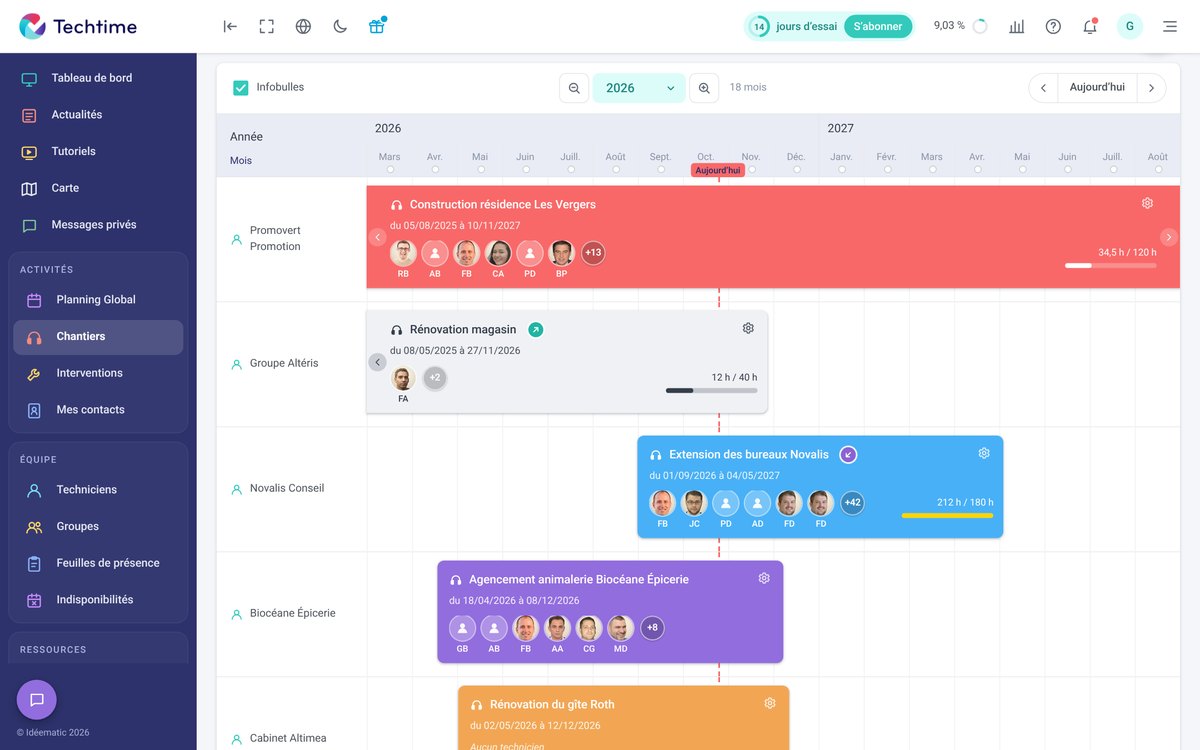
Planning of construction sites and interventions in the Techtime application

Techtime

Techtime combines a web management application for the business owner with a mobile app for technicians in the field. On the web, the company plans construction sites and interventions, assigns resources and monitors activity. On mobile, technicians check their schedule and the information they need for their interventions, then report their hours, photos, observations or questions directly. This information is then available on the web side to monitor activity.

See the Techtime case study
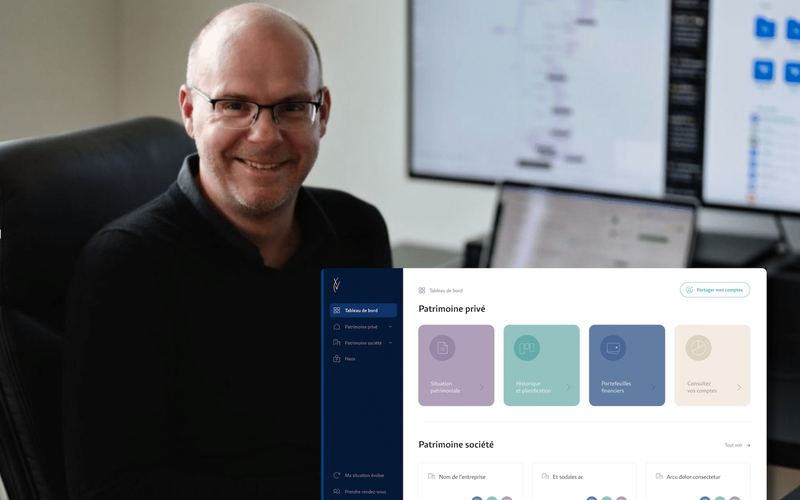
Interface of the Groupe Quinze wealth management platform

Groupe Quinze

Groupe Quinze relies on a wealth management business application that brings together asset data, assignments, tasks, documents and partners. The platform also organises differentiated access rights so that clients, internal teams and external experts can work together in a single environment.

See the Groupe Quinze case study
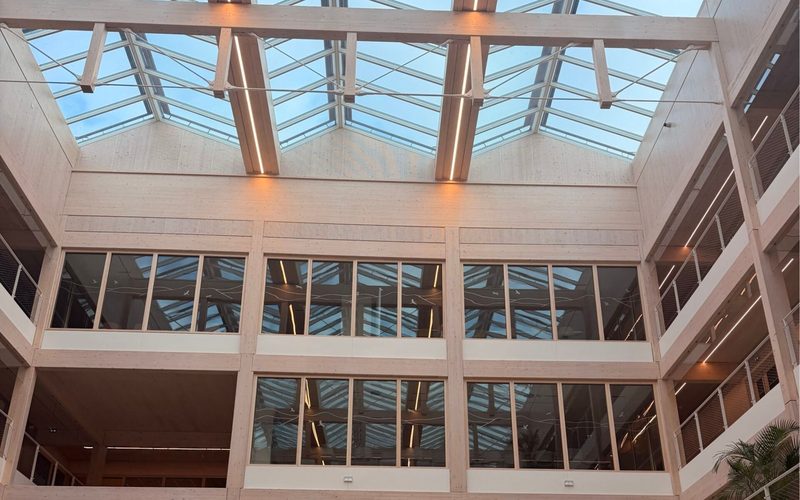
KS Groupe headquarters in Strasbourg

KS Groupe

KS Groupe uses a custom CRM to structure sales follow-up across several subsidiaries without imposing the same way of working on each one. Contacts, customers and opportunities are brought together in a shared repository, while access rights vary by profile and remit. An opportunity can remain specific to one subsidiary or become cross-entity when it involves several companies in the group. The CRM also includes traceability mechanisms and rules specific to the group’s activities, particularly property development.

See the KS Groupe case study
Building under construction and cranes

RE-GROUP

RE-GROUP structures the entire land search chain in a business application. Opportunities and their documents are centralised, then the software applies the rules and financial calculations needed to qualify each case. Depending on the result, a deal can be rejected, examined further or continue through an approval workflow involving land developers and property development groups. The workflow then follows the case through to contract signature and the notary’s involvement, while keeping a history of proposals and decisions.

See the RE-GROUP case study
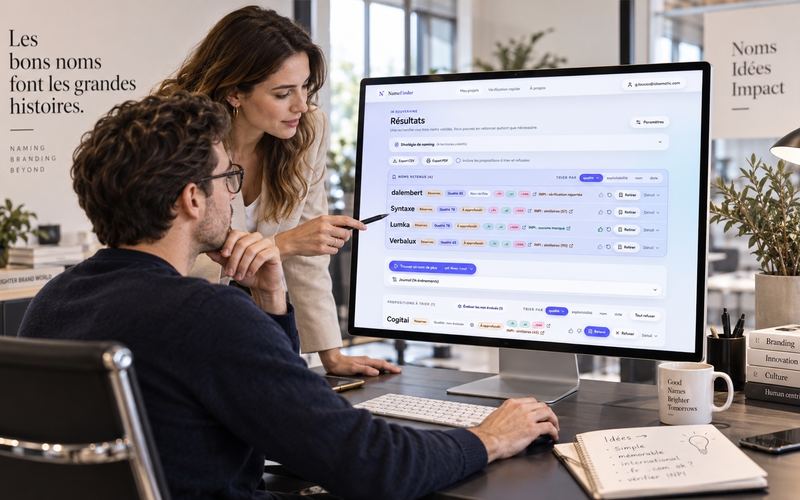
Team reviewing the results of the NameFinder application

NameFinder

NameFinder shows how artificial intelligence can be built into the core of a business application. From a brief and criteria specific to each naming project, the application generates and qualifies proposals, checks domain names and queries INPI (French trademark office) data. The results are brought together in a single workflow, while the professional keeps the final say on which names to keep or reject.

See the NameFinder case study

Business applications by area

Frequently asked questions

What is the difference between a bespoke business application and off-the-shelf software?

Off-the-shelf software (a software package) imposes the same way of working on every company that uses it. A bespoke business application reflects your management rules, your roles and your workflows, and integrates with your existing tools. It is justified when your processes are specific to you or when several tools need to work together.

How much does a bespoke business application cost?

Each project is priced after an initial conversation and a scoping phase. The budget depends on the number of processes covered, integrations with the IT landscape and security requirements.

How long does it take to develop a business application?

From a few weeks to a few months, depending on the scope. The scoping phase sets a precise schedule.

Do you need a web application or a mobile app?

It depends on your users and their working context. Many projects combine the two: a web application to manage and administer, and a mobile app for teams in the field, as with Techtime. For mobile, the choice of technology depends on your constraints: React Native or Flutter for a business application (in French).

Who provides maintenance after go-live?

A corrective maintenance warranty covers your application for a period set out in the contract. We then provide evolutive maintenance (application maintenance and support): enhancements, updates and monitoring, so that your software keeps pace with your business.

Can a business application include artificial intelligence?

Yes, when AI adds real value. NameFinder, for example, generates and qualifies name proposals, while the professional keeps the final say. We also use AI to prototype during scoping and to analyse your existing data. The design, quality and accountability of the software remain with our teams.

Let’s talk about your business application.

An initial conversation to understand your needs and constraints.

Describe my projectAsk a question