
Bespoke software · Web application
Bespoke web application development
A bespoke web application gives you a tool that runs in the browser and is genuinely tailored to how your teams, customers or partners work. It can meet specific business needs, centralise data, automate certain processes and integrate with your IT landscape.
Dashboard
Cases
Documents
Messages
Settings
Partner area
CustomersPartnersInternal teamsIllustration: one web application, with a dedicated area for each audience.
Definition
What is a bespoke web application?
A web application is application software hosted on a server and accessed through a web browser. Unlike traditional software, users of a web application do not need to install it on their computer. They simply connect to the application using their preferred browser.
A bespoke web application is designed for a specific organisation: its features, data, access rights and integrations are built around how you work, instead of adapting your teams to a generic tool.
Idéematic designs and develops web applications tailored to your organisation, from defining the need through to go-live and further enhancements. For projects spanning several processes, applications or components of the IT landscape, discover our approach to bespoke software development.
See also: the definition of a web application and the benefits of a hosted application compared with installed software.
Website
- Role
- Present, inform, sell.
- Access
- Public, from a browser.
- Updates
- Publishing content.
Web application
- Role
- Getting tasks done: entering, processing, approving, tracking.
- Access
- From a browser, with an account and access rights.
- Data
- Centralised on a server.
- Updates
- Deployed once, for all users.
Installed software
- Role
- Getting tasks done on a given workstation.
- Access
- After installation on each workstation.
- Updates
- To be installed on each workstation.
Uses
A web application tailored to how you work
A bespoke web application can serve very different purposes: internal management tool, customer platform, extranet, collaborative workspace, booking portal, back office or SaaS platform. Its design depends first and foremost on the users, the data to be handled, the expected features and the environment it must fit into.
Internal management tool
Centralise the data and processes of a department or the whole company.
Business applicationCustomer portal
Give your customers access to their information, documents and procedures.
Groupe QuinzeParis schedule illustrates this approach: Idéematic designed an online booking platform and a management application for the teams. After analysing user journeys and functional needs, we defined the application architecture, then developed a responsive interface to present offers and manage bookings. On the administration side, the application centralises orders, the organisation of services and invoicing.
We can work on a new project or on an existing application. In the latter case, a technical audit assesses its architecture, code and constraints before considering a takeover or further development.
Approach
From design to development of your web application
- 1
Clarify the purpose
A bespoke web application starts by clarifying its purpose: who will use it, to carry out which tasks, with which data and in which software environment. Together, we define the priority features, user journeys and any interactions with your existing tools.
- 2
Scope and design
This scoping and design phase sets a functional scope before development. Depending on the project, it may rely on workshops, wireframes or prototypes to validate screens, journeys and key choices before development starts.
- 3
Develop in stages
Development then proceeds in stages, with regular discussions and interim approvals. Features are tested before go-live to check their behaviour, consistency and fit with the defined uses.
- 4
Keep the application alive
Our work does not stop at delivery. A web application is a software product meant to live: it can receive corrective and evolutive maintenance as new needs arise.
Integration
A web application integrated into your IT landscape
A web application does not necessarily work in isolation. It can use data already held in your company and exchange information with a CRM, an ERP, business software, an e-commerce platform or external services.
We design the APIs and interfaces needed to organise these exchanges, avoid unnecessary re-keying and keep information consistent across tools.
Diagram: exchanges go through APIs, with no re-keying between tools.
- The wealth management web application Tailorfin is a concrete example. It integrates Yousign for e-signing the contracts generated by the application and Brevo for sending transactional notifications.
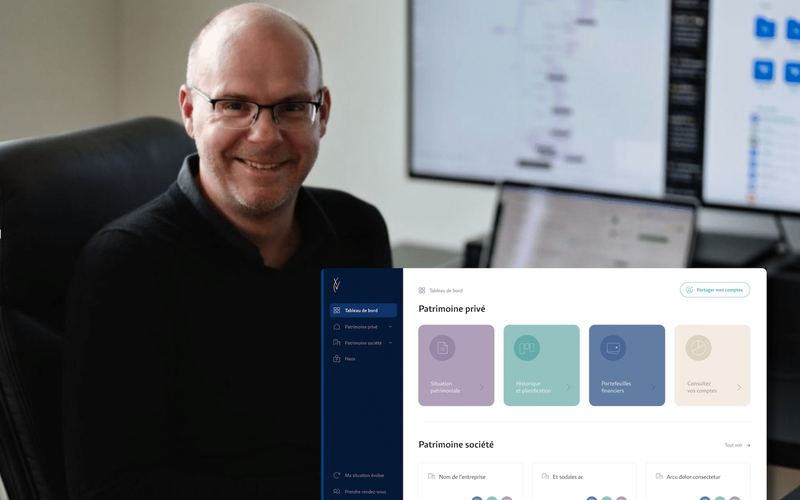
- MyInvest, the Groupe Vivialys property extranet, illustrates another form of integration. Partners can search for properties and take sales actions there, while the necessary information and approvals flow to and from the CRM used by the internal teams.
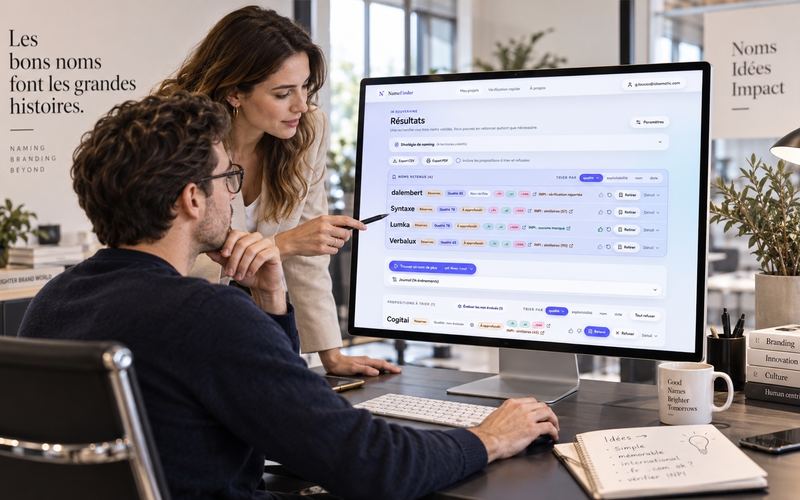
- NameFinder also illustrates this integration approach. This AI-assisted naming web application combines OpenAI to generate and qualify proposals, Domainr / Fastly to check domain names, and INPI (French trademark office) data for trademark searches. The results from these services are normalised, then brought together in a single business workflow before human review.
The architecture is designed around the project: data volumes, number of users, access rights, services to connect and future development. The aim is to build a web application that can integrate with your technical environment over the long term.
See also: ERP, CRM and API integration.
Illustration: each profile accesses the information and functions that concern it.
Security
Security, access and reliability of the application
A professional web application must also control access to data and features. Depending on the project, we can set up different user profiles, access rights matching each person’s responsibilities, and authentication mechanisms consistent with the existing environment.
The Groupe Quinze project illustrates this fine-grained access management: clients, administrators and partners have different rights depending on their role, the assignments they take part in and the wealth information open to them.
Reliability is also addressed throughout development: checks on data exchanges, feature testing, error handling and verification of the application’s behaviour before go-live.
These choices are made according to the real context of the project, the users, the data handled and the level of requirements expected.
Technologies
Technologies chosen to suit the project
Technologies are chosen once we understand the need, the uses, the technical constraints and the existing environment.
Depending on the project, we work in particular with Ruby on Rails, React, JavaScript, Node.js or Python, together with the tools and services needed for the architecture, APIs, databases and deployment of the application. When the application publishes content, we manage it with a bespoke or headless CMS.
The Groupe FED project illustrates this approach: several sites moved to a Ruby on Rails architecture, with features tailored to the group’s different brands.
The aim is not to impose a technology, but to choose an architecture consistent with the project, its level of complexity and its future development.
Case studies
Web applications in production
 Web and mobile application
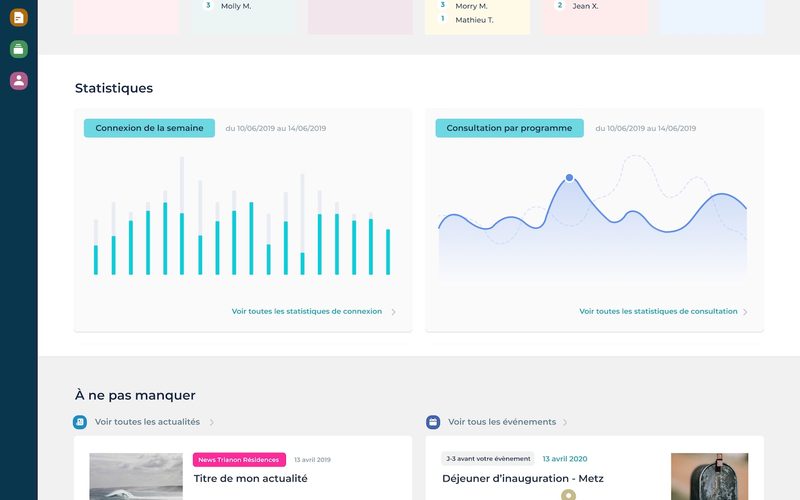
Tailorfin, a web and mobile wealth management application
 Partner extranet
MyInvest, a property extranet for Groupe Vivialys partners
 Customer and partner portal
Groupe Quinze, a bespoke wealth management platform for clients and partners
 Web application · Artificial intelligence
NameFinder, an AI-assisted naming business application
Frequently asked questions
What is the difference between a website and a web application?
A website presents, informs or sells. A web application lets its users carry out tasks: entering, processing, approving or tracking information, with an account and access rights suited to each person. Both are used from a browser.
What is an extranet or an intranet?
An intranet is a company’s internal network, deployed for private use. Similar to an intranet, an extranet is deployed over the internet and used between companies or with external collaborators through login credentials. See the full definition.
Why work with a web application development agency?
A web application development agency brings together the skills needed for the whole project: scoping, journey design, development, integration with your IT landscape, then maintenance. It commits to the result and supports the application over the long term.
How long does it take to develop a web application?
From a few weeks to a few months depending on the project: the number of profiles and features, integrations with your tools and migration of existing data all affect the timeline. Scoping makes it possible to define it before development.
How much does a bespoke web application cost?
Its cost depends on the functional scope, the number of user profiles, integrations with your IT landscape, security requirements and data migration. Scoping makes it possible to price an initial scope before committing to development.
Can you take over an existing web application?
Yes. We can work on a new project or on an existing application. In the latter case, a technical audit assesses its architecture, code and constraints before considering a takeover or further development.
Which technologies do you use?
Depending on the project, we work in particular with Ruby on Rails, React, JavaScript, Node.js or Python. Technologies are chosen once we understand the need, the uses, the technical constraints and the existing environment.
Does a web application work on mobile?
Yes. A responsive interface adapts to smartphone, tablet and computer screens, like the Planning Paris booking platform. When usage requires it, a mobile app can complement the web application, as with Tailorfin.
A web application project?
Tell us about your users, your data and your tools: we will work out the right application with you.