
Réalisation · Artificial intelligence
NameFinder, an AI-assisted naming business application
Idéematic designed and developed NameFinder, an AI-assisted naming business application for brand creation professionals, set to be marketed to specialist agencies and consultancies.


In brief
Idéematic
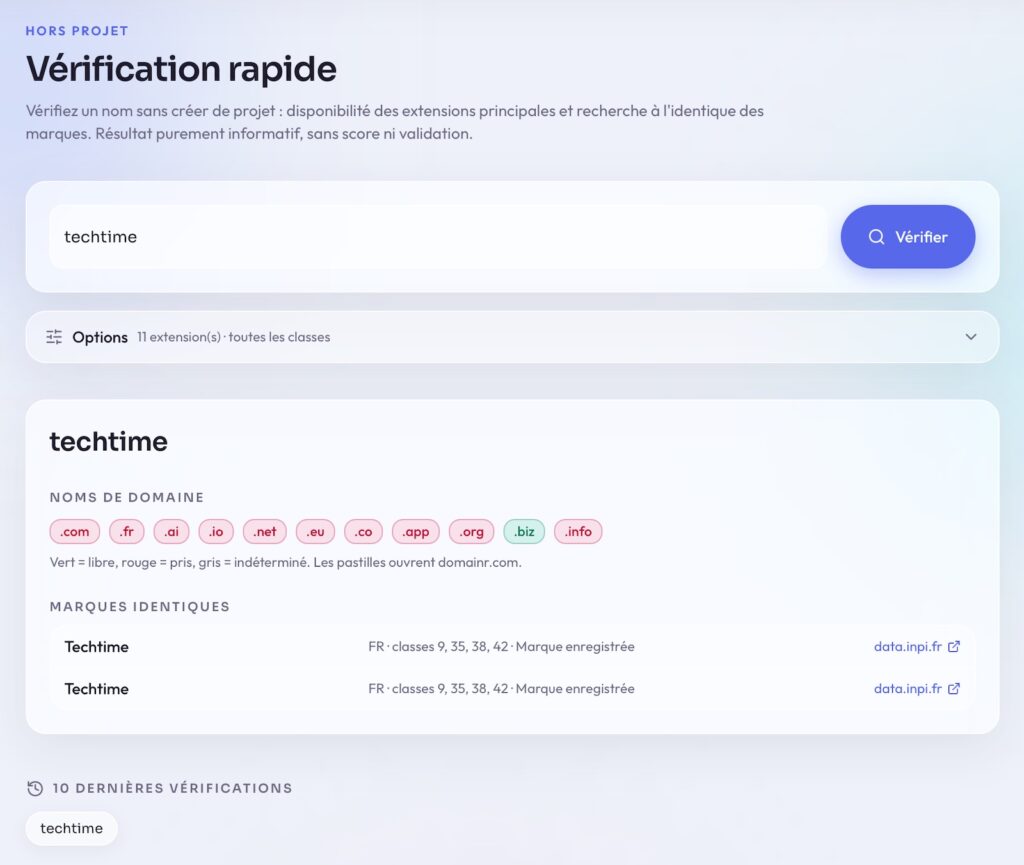
Based on a brief and criteria defined for each project, the application generates and qualifies proposals using a built-in naming methodology. It also checks domain name availability and runs identical-mark searches in trademark data, before gathering the results in a record the user can act on.
NameFinder does not replace human expertise: the application automates generation, checks and qualification, while the consultant keeps the final decision on which names to keep or discard. The project thus combines generative AI, business rules, external data, API integrations and human validation within a single workflow.
- Business
- AI-assisted naming solution published by Idéematic
- Our involvement
- Artificial intelligence, Business application, Scoping & design, Systems integration & IT, Web application
The context
Industrialising naming work that was still largely manual
Creating a brand name is not just about generating ideas. Each proposal must also be checked against the intended positioning, the criteria set out in the brief, domain name availability and trademarks already registered in the relevant Nice classes.
Done manually, this work means running search after search, consolidating the results and then discarding a large share of the names proposed. Qualification can therefore take a great deal of time before a genuinely usable shortlist emerges.
NameFinder was designed to industrialise this research and qualification chain. The application centralises the brief, generates AI-assisted proposals, applies business checks, queries the relevant external sources and then gathers the results in a single environment.
The aim is to speed up the preparatory work without automating the final decision: the application qualifies and documents; the naming professional decides.

Project scoping
Turning a brand brief into criteria the AI can use
NameFinder does not start with a simple prompt sent to an artificial intelligence model. Each search is first structured around a naming project that defines the context, objectives and constraints to be met.
The professional enters, among other things, the business sector, the brand brief and the expected style criteria: maximum length, sound, target language, type of name, and prefixes, suffixes and wording to avoid. These parameters directly guide the generation of proposals.
The project also includes the domain name extensions to check and the relevant Nice classes for the trademark search. These criteria can be set as mandatory or preferred, to distinguish essential conditions from secondary preferences.
This scoping phase turns a creative intention into a set of structured rules. The AI works from this business data rather than from a generic request, which produces proposals more consistent with the intended positioning.
Artificial intelligence and business methodology
Framing the AI with a naming method rather than simply asking it for ideas
NameFinder does not rely on free-form name generation by artificial intelligence. The AI is embedded in a structured business methodology, designed to produce proposals consistent with the brief, the project’s constraints and the professional’s expectations.
Generation draws on several creative routes and on precise rules for construction, spelling and quality. A second AI process then acts as an independent panel: it assesses the proposals against an internal scoring grid, assigns a score and can flag criteria serious enough to rule out a name even before the external checks.
Each project also builds up its own memory. Names already produced, rejections, ratings and user comments are kept and fed back into subsequent searches. The application can thus avoid duplicates and gradually refine its proposals according to the preferences actually expressed.
This architecture uses AI as a building block for creative support and qualification, while keeping it within an explicit, traceable and controllable business framework.
Qualification and automated checks
Checking each proposal against quality criteria, domains and existing trademarks
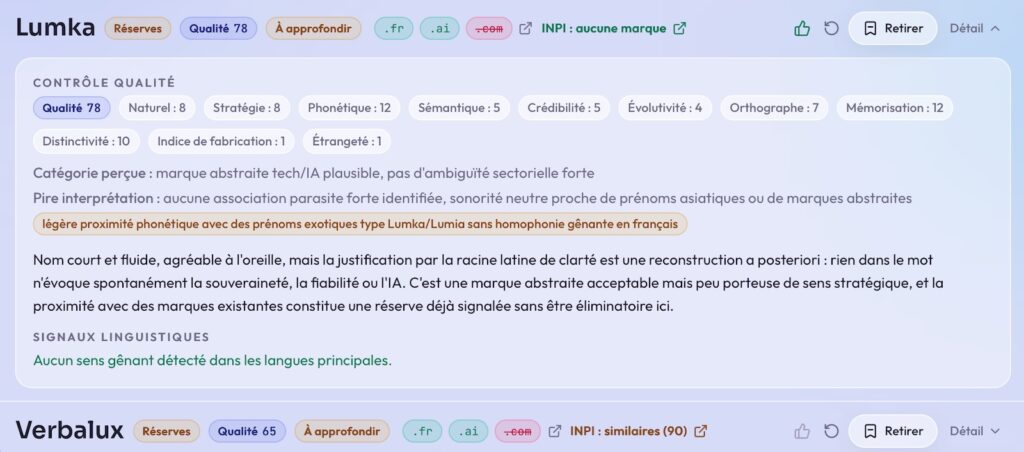
An AI-generated proposal is never considered usable without checks. NameFinder first applies mechanical rules to the project’s non-negotiable criteria, then submits the remaining names to an independent quality assessment. This analysis measures, among other things, memorability, distinctiveness, pronunciation, consistency with the positioning and various linguistic signals.
Names that pass this stage are then checked against the external sources defined in the project. The application automatically checks the availability of the selected domain extensions and queries INPI (French Patent and Trademark Office) data for identical trademarks in the relevant Nice classes. Similar trademarks can also be flagged as points of caution.
NameFinder consolidates this information in a single record with a status, a rating and any points of caution detected. Users can thus understand why a name deserves further investigation, why an extension is a problem or why an additional legal check is needed.
These checks are deliberately informative and preparatory. An identical-mark search in INPI data is neither a full clearance search nor legal advice. The decision to keep a name and, where appropriate, to register it remains a human one.
Human decision-making and project memory
Letting the AI propose and qualify, while keeping the decision in the professional’s hands
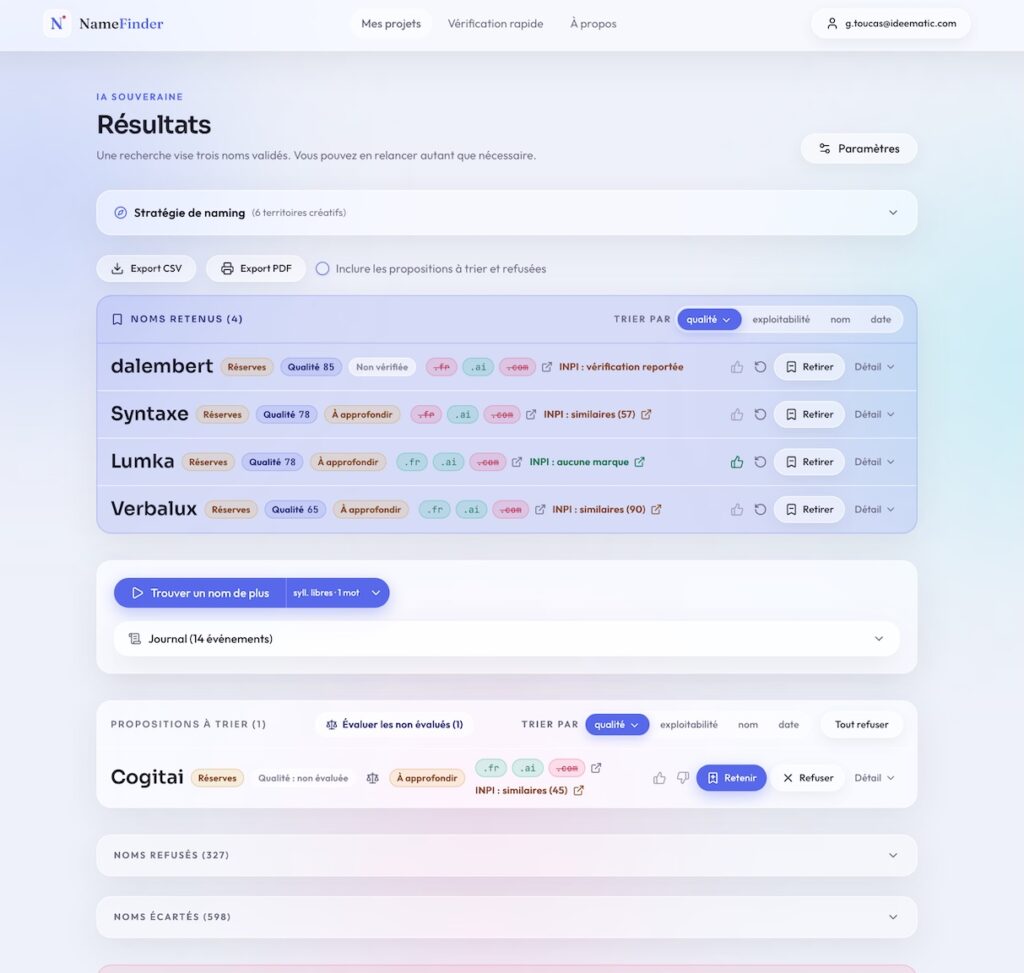
NameFinder is designed as a decision-support tool. The application can generate proposals, score them, flag points of caution and identify grounds for rejection, but it does not decide on the professional’s behalf. Each name remains subject to an explicit human decision: keep, reject, comment or request a new assessment.
Proposals are organised by status: kept, to be sorted, rejected or discarded. Users thus keep a clear view of the search’s progress and can revisit a proposal when new information or a change of strategy warrants it.
This interaction also feeds the memory specific to each project. Names already generated, grounds for rejection, ratings and comments are kept and reused in subsequent searches. NameFinder thus avoids repeating the same proposals and gradually adapts generation to the preferences actually expressed by the user.
A ground for rejection can even be turned into a project rule. The application does not merely record decisions: it can build them into the next generation process, while keeping a record of the decision made.
Integrations and external sources
Connecting the AI to the sources needed to genuinely qualify each proposal
NameFinder does not work in isolation. The application combines several specialised services to turn a creative proposal into information the professional can act on.
Generation and quality control rely on OpenAI, called server-side. Domain name availability is checked via Domainr / Fastly, while trademark searches draw on INPI data. These responses are then normalised and consolidated in the application so that users do not have to run multiple manual searches.
The integration was also designed to take each service’s constraints into account. INPI calls are monitored to stay within the hourly quota. When the limit approaches, some checks can be deferred and then resumed automatically, without interrupting the rest of the search. Domain checks are also throttled to respect the provider’s limits.
All calls to external services are made server-side. Keys and secrets are never exposed in the browser, and errors are handled so that users always see an understandable state. This architecture connects several APIs to the same workflow while keeping a consistent, controlled interface.
Technical architecture and security
Building a production-ready AI application without exposing data or secrets
NameFinder was developed as a business web application in React and TypeScript, with a responsive interface that can be installed as a PWA. The front-end stack notably relies on Vite, TanStack Router, Tailwind and shadcn-ui, while data is stored in a PostgreSQL database hosted on a managed cloud platform.
The architecture strictly separates processing carried out in the browser from processing carried out server-side. Calls to OpenAI, Domainr / Fastly and INPI go exclusively through server functions: API keys and secrets are never sent to the browser or stored in data accessible to users.
Project isolation relies on Row Level Security rules applied to the tables containing user data. Authentication protects workspaces, while technical processes have their own rights to prevent any cross-access to another account’s data.
As searches can require many external calls, long-running processes run in the background, split into batches and designed to resume after an interruption or a quota limit. Progress is reported in real time in the interface so users can follow each step without reloading the page.
This architecture brings together generative AI, asynchronous processing, business data, external APIs and access security in an application built for real professional use.


Technologies and connected services
React, TypeScript and PostgreSQL for an AI-enhanced business application
NameFinder’s foundation relies on React and TypeScript for the web application, with Vite and TanStack Router for the front-end structure. The interface uses Tailwind CSS and shadcn-ui, while data is stored in PostgreSQL on a managed cloud platform.
Around this foundation, several specialised services play a direct role in the business workflow:
- OpenAI for generating proposals and independent quality control;
- Domainr / Fastly to check domain name availability;
- INPI to search for identical trademarks and identify close matches;
- PostgreSQL to store projects, proposals, histories, search logs and the caches needed for processing;
- a real-time channel to show the progress of searches and checks without reloading the page.
The challenge was not to add up technologies, but to build an architecture able to make generative AI, business rules, external data, asynchronous processing and human decisions work together in a coherent process.


Do you have a plan for an AI-enhanced business application?
Idéematic designs bespoke applications able to integrate artificial intelligence into real business processes: using your own data, automating processing, connecting to external services and keeping human validation wherever decisions require it. As with NameFinder, we can turn business expertise and its own rules into a reliable, secure application designed for real professional use.