
Réalisation · Business application
RE-GROUP, bespoke software for property development
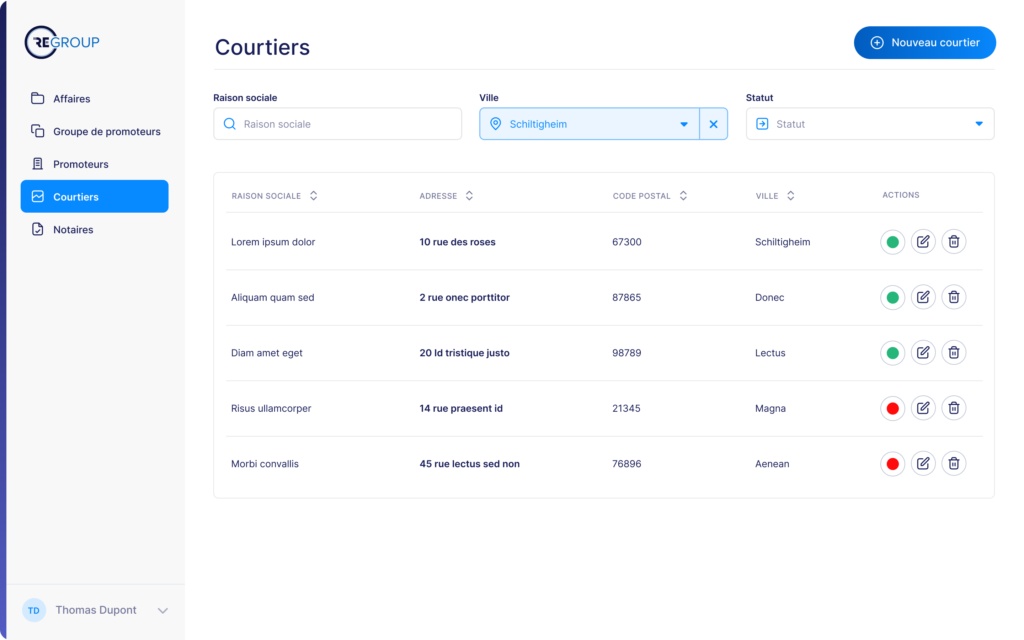
RE-GROUP entrusted Idéematic with the definition and design of a web application to structure land sourcing for its property development operations. The challenge: turning a process that relied heavily on Excel into a business platform able to centralise files, automate their financial analysis and coordinate the various stakeholders involved in processing them.


In brief
RE-GROUP
Our work consisted of translating complex business rules into user journeys, data, calculations, access rights, documents and approval workflows. The functional scope covers land sourcing, from submitting an opportunity through to its analysis, allocation, contract signature and the notary’s involvement.
- Business
- Property development
- Our involvement
- Business application, Scoping & design, Systems integration & IT
From Excel to a business platform
Structuring the entire land sourcing chain
Finding a property opportunity involves technical, land, financial and contractual information that evolves throughout the file. At RE-GROUP, a central part of this process had until then been managed in Excel.
The aim was to build a single environment to collect the opportunities submitted by brokers, centralise their data and documents, and then move each file forward according to precisely defined rules.
The application therefore had to become much more than a storage tool: a genuine support for the business process, able to guide each deal from its identification through to the decision and contract signature.
A multi-stakeholder process
Giving everyone the right role at the right time
A single opportunity can involve profiles with very different responsibilities: broker or introducer, administrator, land developer, active or passive property developer, development group and notary.
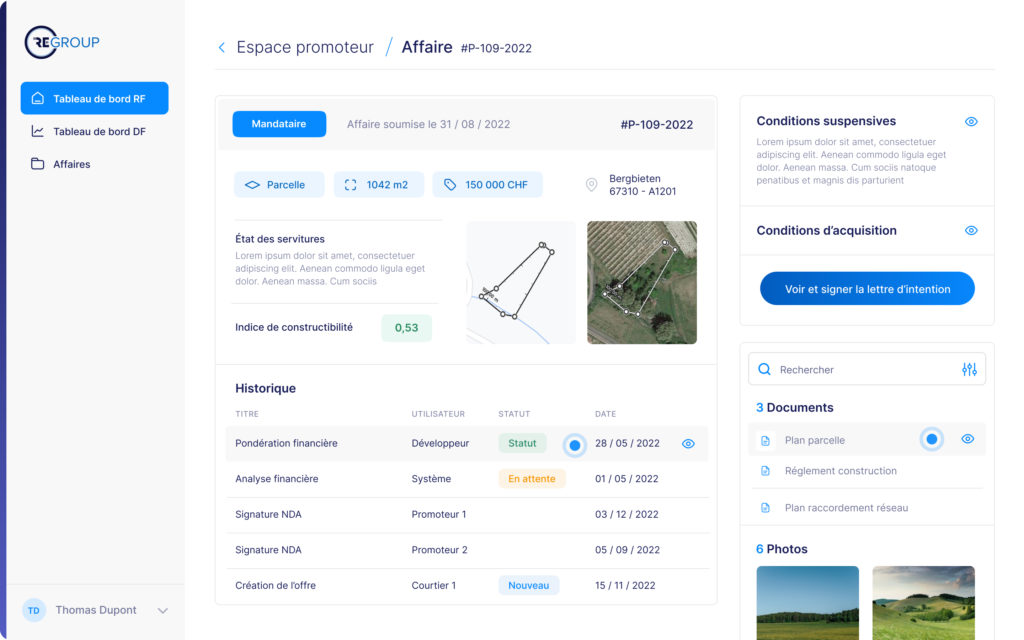
We therefore structured the application around specific profiles and journeys. Each user accesses the files and actions matching their role: submitting an opportunity, analysing its feasibility, reviewing a proposal, setting participation terms, signing a document or working on legal deeds.
This organisation lets a single deal move between several stakeholders without duplicating information, while controlling what each party can view or edit at every stage of the process.
Very different land files
Standardising data collection without oversimplifying the business
Not all land opportunities are described in the same way. The structure of the expected information varies depending on the type of property under review.
The application notably distinguishes between plots, buildings to be demolished, buildings to be refurbished, income-producing buildings and portfolios of several income-producing buildings.
For each type, we defined the data and documents needed for the analysis: location, land registry, floor area, plot ratio, easements, building regulations, plans, utility connections, photographs and rental data where the property is already let.
The software can thus impose a common framework for data collection while tailoring each file precisely to the information needed for each type of opportunity.

A business analysis engine
Turning financial formulas into decision support
One of the major challenges was to stop relying on an Excel file to assess the economic viability of an opportunity. The rules and formulas used by RE-GROUP had to become directly usable by the application.
Based on the information entered in the file, the software calculates the indicators needed for the preliminary appraisal and qualifies the opportunity. Depending on the result, the file can be rejected, require further analysis or continue through the validation process.
The land developer also has an additional level of analysis. They can examine the criteria that influenced the result, adjust a weighting and study different scenarios before ruling on the deal’s feasibility.
This logic turns expertise previously held in spreadsheets into structured, reproducible business rules built into the user journey.
A bespoke validation workflow
Orchestrating decisions across several development groups
An opportunity deemed relevant then enters a decision process potentially involving several development groups. The software therefore had to manage not only the file, but also its status changes, its allocation and the successive decisions of the various parties.
A deal can be sent to one or more groups with participation terms and a deadline. Each developer concerned then has their own review and approval journey, with the documents needed to make their decision.
Proposals, acceptances and any counter-proposals must remain attached to the file to preserve the continuity of exchanges and the decision history. The process can thus move forward without losing the context that led to each new stage.

Documents and contracts
Moving documents forward with the deal
In this type of process, a file does not progress through status changes alone. Each stage may also require producing, sending or approving documents that commit several parties.
The application was therefore designed to link documents directly to the workflow: non-disclosure agreements, participation terms, letters of intent, allocation documents and draft deeds. Information already in the file can be reused to avoid re-entering data and to prepare certain documents from templates.
E-signature is built into this journey so that a document’s progress stays tied to that of the deal. The notary’s involvement extends this logic through to the draft deeds and the filing of the final document that closes the land sourcing phase.
Deadlines under control
Giving an immediate view of progress
Decisions on a land operation are constrained by many deadlines. A missed date or late approval can slow down the whole process.
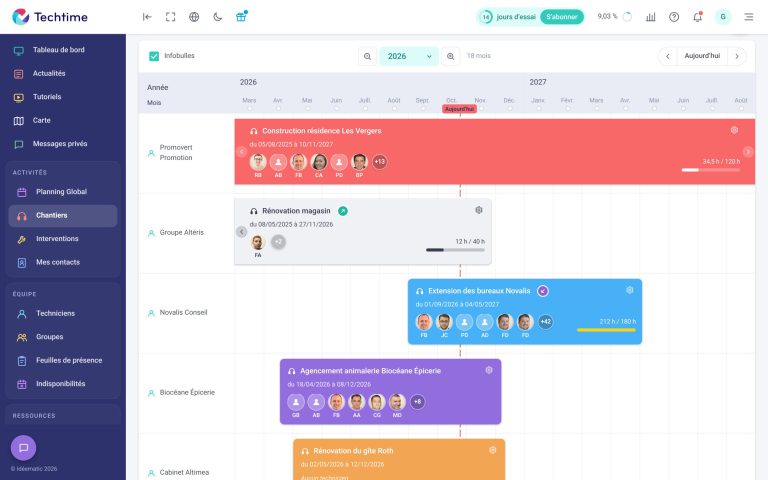
We therefore built the notion of time directly into the software’s design. Each deal can follow a schedule made up of deadlines and successive stages, with reminder mechanisms to alert users before a deadline is reached.
A timeline view shows the progress of the various files and immediately identifies the stages that have been approved, those approaching their deadline and those requiring action.


In-depth functional design
Modelling 63 templates before writing any code
Business software of this complexity cannot be defined by a list of features alone. You need to understand the stakeholders, the rules, the status changes and all the consequences of an action on the rest of the process.
The scoping work carried out with RE-GROUP resulted in a detailed sitemap and 63 functional templates covering the application’s various profiles and key moments: creating a deal, analysis, allocation, review by developers, contracts, signature and the notary’s involvement.
The journeys were then translated into functional test scenarios precisely describing the user context, the actions carried out and the expected result. This formalisation turns complex business operations into a specification that can be used for development and acceptance testing.
Technical architecture
A Ruby on Rails foundation suited to business workflows
The technical architecture defined for RE-GROUP is based on Ruby on Rails combined with PostgreSQL. This foundation is particularly well suited to an application in which data is highly interconnected and each deal passes through many states, rules and interactions.
The application must also communicate with several external services required by the business process, notably for transactional emails, notifications and e-signature. Processing that does not require an immediate response can run asynchronously so as not to slow down user journeys.
Unit tests complete this architecture to secure the business rules and limit the risk of regressions as the software evolves.


A complex business process to turn into software?
When your business relies on rules, calculations, documents and approval workflows that do not fit into standard software, Idéematic designs a bespoke application around the way you work. From scoping to integrations, we turn your processes into a reliable, structured tool that can evolve with your organisation.