
Case study · Bespoke CRM
KS Groupe, a bespoke CRM to manage sales opportunities
KS Groupe entrusted Idéematic with the design and development of a bespoke CRM to structure the sales follow-up of its various subsidiaries. The aim: shared business software to centralise contacts, customers and opportunities, while respecting the processes, access levels and specific features of each group entity.
In brief
A bespoke CRM for a multi-subsidiary group
Our work covered the functional definition, data and rights modelling, sitemap, use cases, wireframes, interface design, technical choices and then the development of the application.
The client · Construction and property
KS Groupe currently presents itself as an independent construction and property group, with expertise covering construction, property development, energy, urban development and building engineering.
The context
Unifying the sales follow-up of a multi-subsidiary group
KS Groupe brings together several subsidiaries and departments whose activities, sales organisations and levels of access to information differ. Contacts can come from different channels depending on the entity, and an opportunity identified by one subsidiary may also interest another company in the group.
The future CRM therefore had to create a shared system of record without imposing the same way of working on everyone. Teams needed to share useful information, identify cross-entity opportunities and build a qualified contact database, while keeping each subsidiary’s own rules.
Another challenge concerned data quality. Companies had to be uniquely identified, notably by their SIRET number, to limit duplicates and make it easier to link contacts, stakeholders and opportunities.
The challenges
Sharing information without losing control of access rights
In a CRM used across a group, centralising data does not mean that every user should be able to access all the information.
The system was therefore designed around fine-grained management of roles and scopes. Administrators, group or subsidiary management, sales management, sales teams and administrative profiles have different rights to read, create, edit, assign or share.
An opportunity can itself be private, limited to one subsidiary or become cross-entity when several group entities are involved. This logic lets sales information circulate when relevant, while protecting data that must remain confidential.
This rights management is accompanied by a traceability requirement. The main changes made in the CRM must be logged so that the action taken, its author, its date and the values before and after the change can be identified.
Scoping
Turning KS Groupe’s business rules into a functional architecture
Before starting development, we translated the group’s sales operations into a functional model the application could use.
The scoping work defined the CRM’s main entities and their relationships: contacts, customers, stakeholders, opportunities, users, activities, notes and milestones. Needs specific to property development also led to modelling developments, buildings and lots that can be linked to opportunities.
We then detailed the user profiles, associated rights, the application’s sitemap, usage scenarios and expected features. The key interfaces were produced as wireframes to validate the journeys and interactions before development.
This stage turned a large set of sales and organisational rules into a coherent architecture of data, relationships, rights and user journeys.
Bespoke CRM
Building a business tool around the group’s uses
The CRM was designed to let teams work from a shared environment, while tailoring the information accessible to each user’s responsibilities.
Data entry was also designed to limit friction. When a related item does not yet exist, the user can create it from within their journey without interrupting their task. External services can automatically complete certain information, notably from a SIRET number or when entering an address.
It combines several complementary functions:
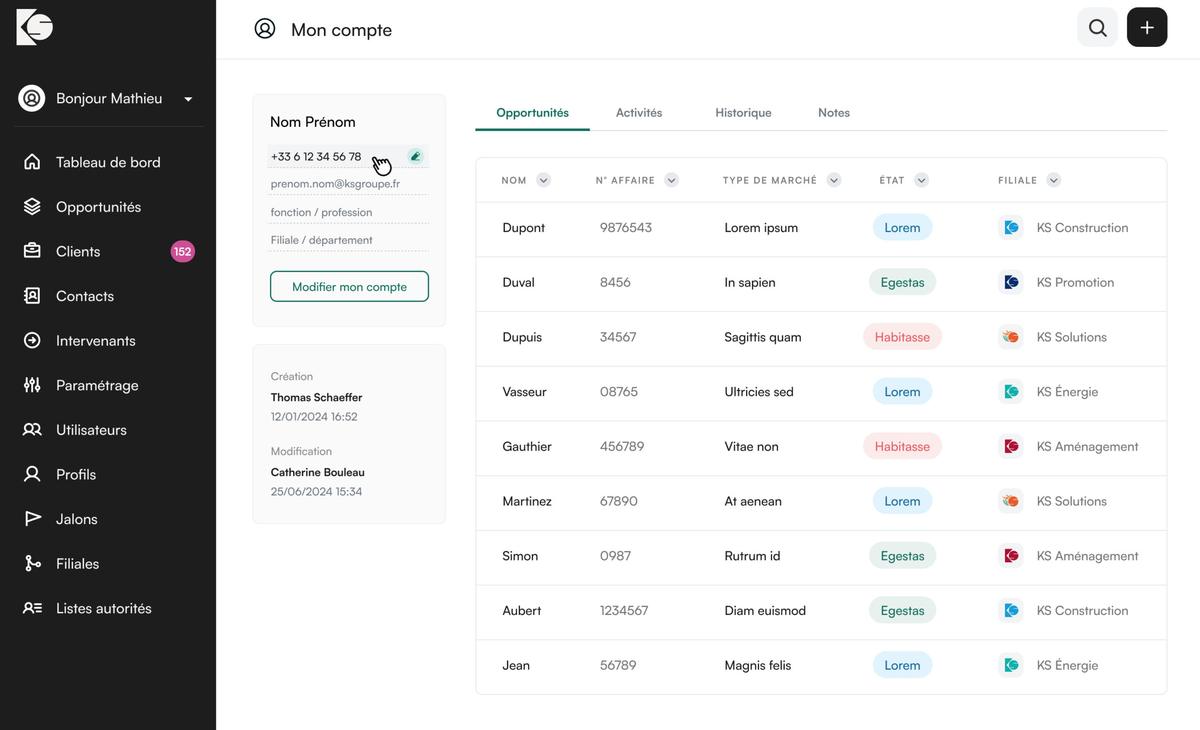
- Centralisation of contacts, customers, stakeholders and opportunities
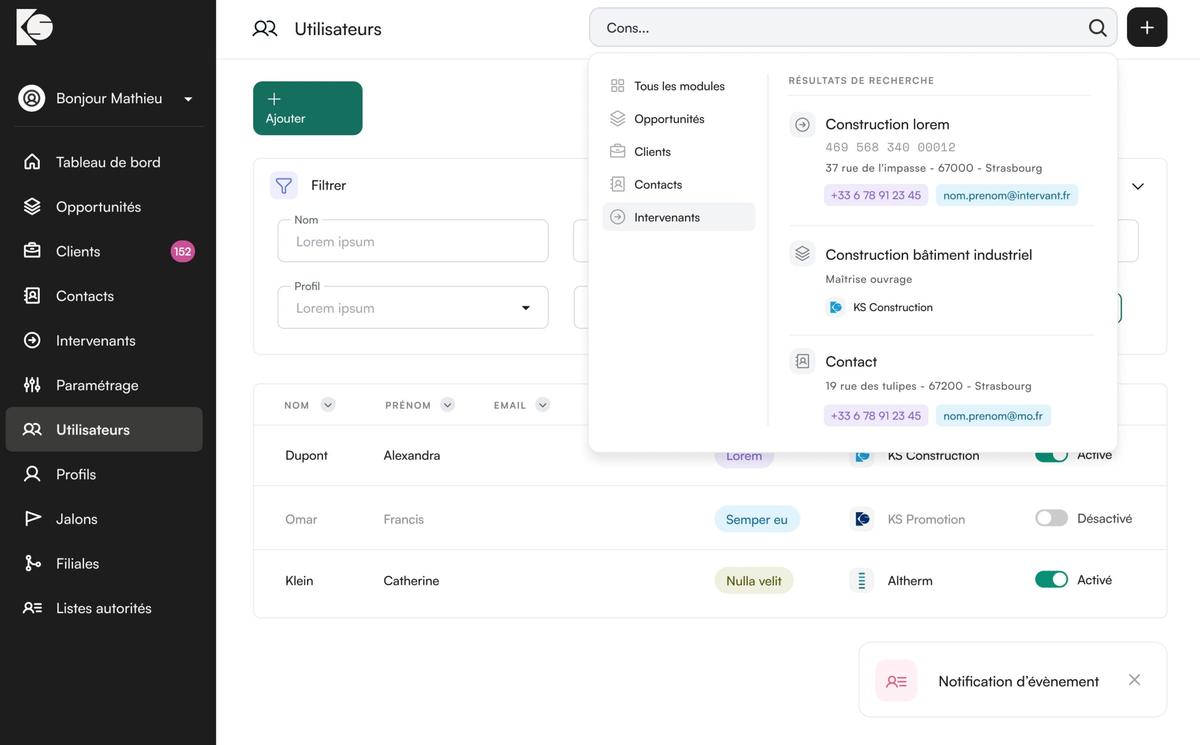
- Multi-criteria search, advanced filters, saved searches and customisable columns
- Tracking of activities, meetings, reminders, notes and attachments
- User mentions and notifications to help information flow
- Export of selected data to Excel
- Customisable dashboard with lists and indicators
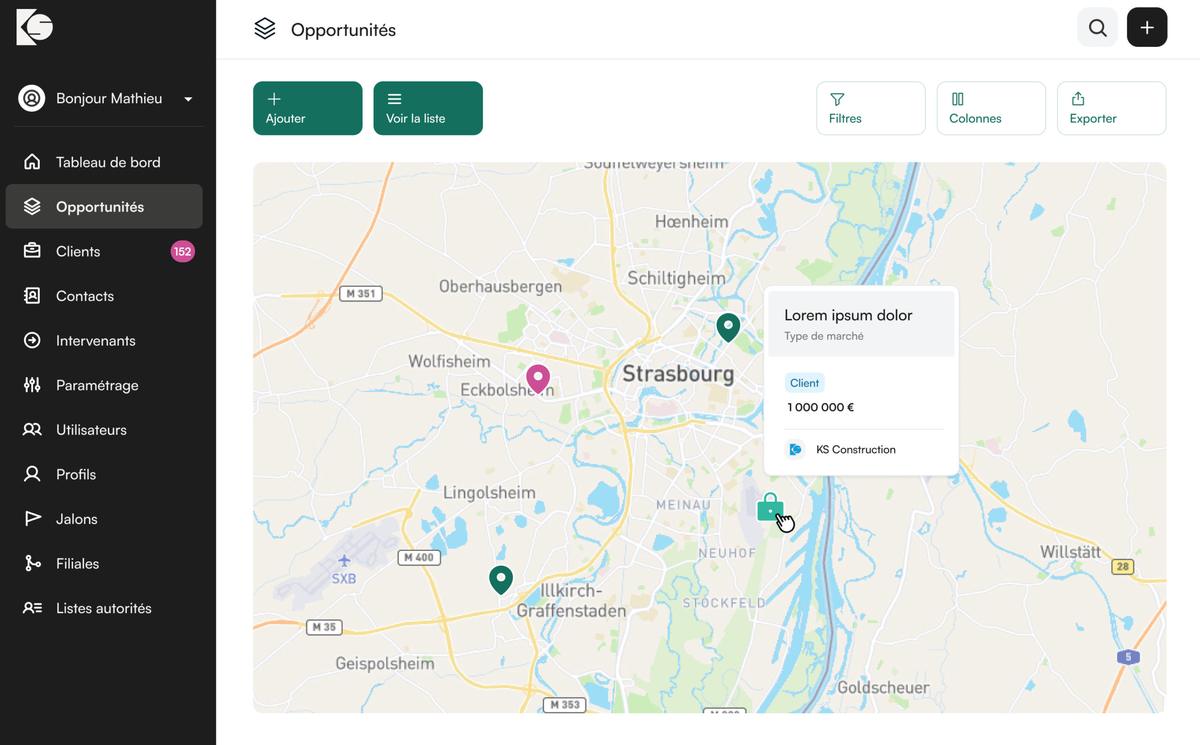
- Geographical view of opportunities on a map
- Initial import of existing data from CSV files
Opportunity tracking
Providing a structured view of the sales pipeline
The opportunity is one of the CRM’s central elements. Its tracking had to match the commercial realities of the group’s different business lines rather than a standard pipeline imposed by off-the-shelf software.
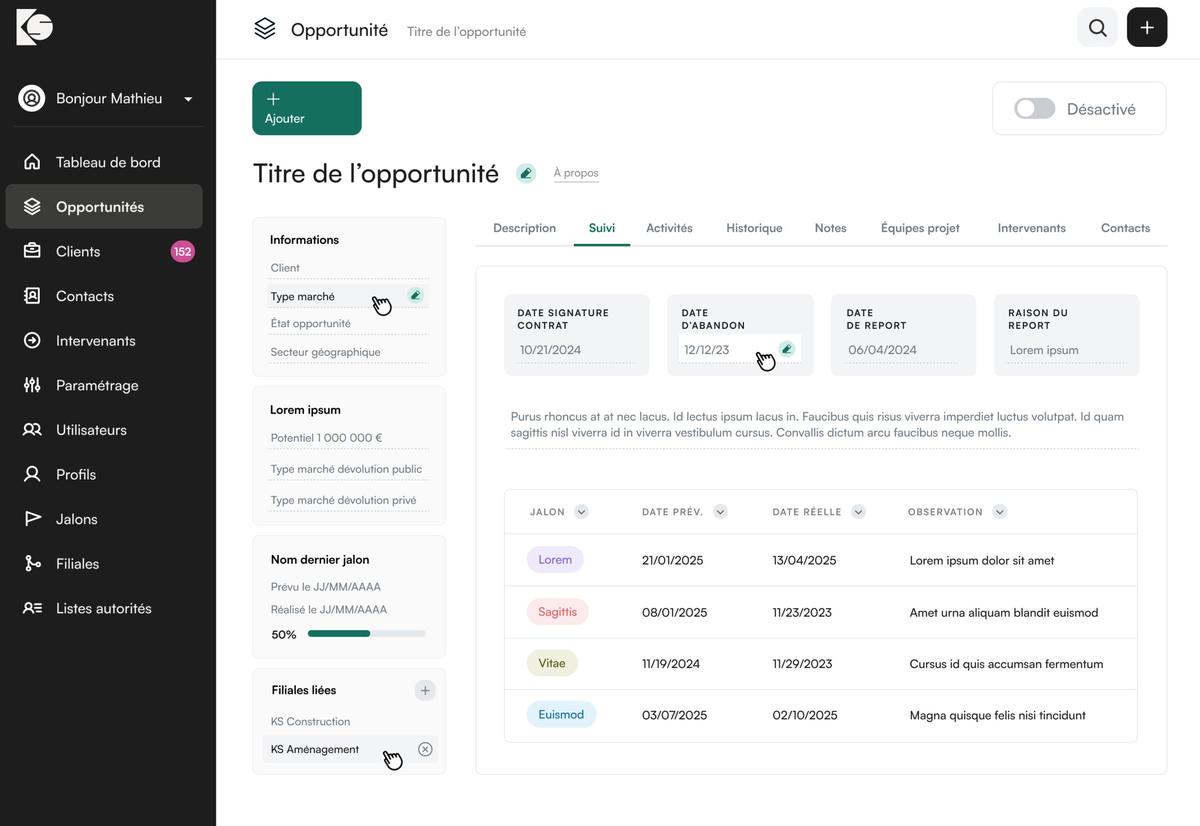
An opportunity can be created even before all the parties involved are known. It can then move through several states and milestones: creation, decision whether to proceed, study phase, intermediate stages, then a final or temporary outcome, for example won, lost, postponed or abandoned.
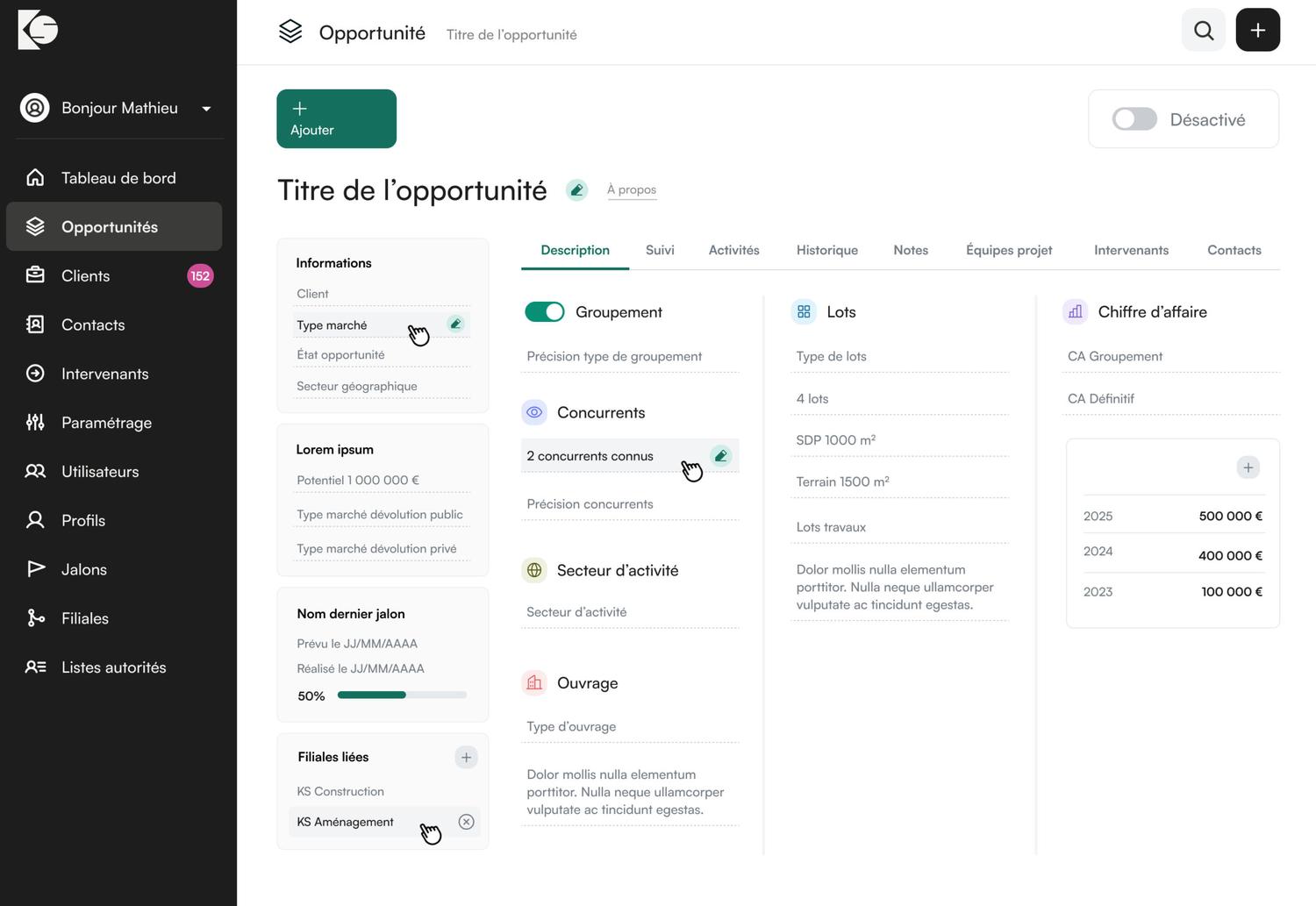
The CRM also makes it possible to assign a probability of success to an opportunity and track its potential revenue. For projects spanning several financial years, this amount can be spread over time to give a more realistic view of the sales potential. The expected amount can then be compared with the final revenue.
Specific mechanisms also meet the needs of the group’s business lines. Opportunities related to property development can, for example, be linked to an organisation structured into developments, buildings and lots.
Security and integrations
Embedding the CRM in KS Groupe’s IT environment
The CRM was not meant to operate as a service isolated from the existing information system.
Authentication was therefore built on the group’s Microsoft 365 accounts, supplemented by two-factor authentication. Given the sensitivity of the sales information handled, access to the application was also designed to take place from KS Groupe’s secure environment via its VPN.
The software also has to exchange data with external services when they simplify everyday use. A SIRET lookup API pre-fills company information, while an address search service makes addresses easier to enter.
These integrations illustrate an important principle of the project: the CRM was not conceived as an additional tool to be managed separately, but as an application designed to fit into the existing organisation and technical environment.
Development
Developing in cycles and validating the solution step by step
Once the functional scope had been defined, development was organised iteratively. Features are delivered progressively so they can be presented, tested and adjusted during the project.
The planned follow-up combines regular check-ins with the KS Groupe teams and functional validation phases. Our team planned with the client a weekly progress meeting and a monthly validation meeting covering features, tests and any adjustments.
The development pipeline also relies on Git version control and unit tests run before code is made available. An exception tracking system completes this set-up to detect any errors the application encounters.
This organisation keeps a direct link between the business rules defined during scoping and their actual implementation in the software.
The technologies
Ruby on Rails and PostgreSQL powering the CRM
The CRM is developed with Ruby on Rails for the application and PostgreSQL for data management.
Around this foundation, several components meet specific project needs: Microsoft 365 authentication, two-factor authentication, state management, search engine, transactional emails, asynchronous task processing and unit tests.
The technical choice thus supports the CRM’s functional requirements: managing a rich data model, many relationships between entities, rights rules, histories, complex searches and processes set to evolve over time.

Do you need a bespoke business CRM?
When market solutions do not match your processes, organisation or business rules, Idéematic designs and develops bespoke CRMs suited to how you work. We work from scoping and needs modelling through to development, integrations and go-live of your software.