
Bespoke software
Bespoke software development built around your business
Idéematic designs, builds, takes over and evolves bespoke software for mid-sized companies and large enterprises: tools built around the way you work, integrated into your IT landscape and maintained over the long term.
Validation
Framework agreement · Purchasing
Illustration: multi-entity management software, on desktop and mobile.
When to choose it
When should you choose bespoke software?
Bespoke software becomes relevant when off-the-shelf tools no longer fit the way you work, your constraints or your objectives.
It may mean replacing several scattered tools, automating tasks that are still manual, better structuring a business process, connecting software that does not communicate well, or creating an application suited to a very specific way of working.
Bespoke software also lets you design a solution that evolves with your organisation, instead of forcing your teams to adapt their methods to the limits of existing software.
We typically step in when you need to:
Today
- Centralise data or operations currently spread across several tools
- Automate business processes
- Create a specific web or mobile application
- Connect several software packages, services or data sources
- Replace a tool that has become too limited or difficult to maintain
- Evolve an existing application
- Add new features, particularly AI-based ones
Types of software
What types of software can we design?
We design bespoke software to meet very different needs, whenever an off-the-shelf solution is no longer enough or imposes too many constraints.
In particular, we can develop:
Manage and steer your business
- Business applications to manage processes specific to your business
- Management, tracking and performance-monitoring software
- Custom CRMs tailored to your sales organisation or customer relationships
- Custom ERPs to run your operations the way your organisation works
Open your tools to your users
- Extranets, intranets and business portals
- Web applications accessible from a browser
- Mobile apps for your teams, your customers or your field users
- Collaborative tools and management interfaces
Connect and enhance your software
- Solutions integrated with your ERP, your CRM, your databases or your third-party services
- Applications with built-in artificial intelligence features
Bespoke development also makes it possible to create very specific digital products. For Bernardaud, for example, we developed a touchscreen application for composing table settings, used in stores and rolled out as far as Bloomingdale’s in New York.
The functional scope depends first and foremost on your business needs. Our role is to turn those needs into a coherent, usable solution that can evolve over time.
Off-the-shelf or bespoke
Why choose bespoke software rather than an off-the-shelf solution?
The choice between off-the-shelf software and a bespoke solution depends mainly on the level of adaptation, integration and evolution your organisation needs.
Bespoke software is therefore not always the best choice. It becomes relevant when adapting to your processes, integrating with your IT landscape or being able to evolve the tool are important issues for your business.
| Off-the-shelf software | Bespoke software | |
|---|---|---|
| Fit with your needs | Features designed to cover widely shared needs | Features defined from your processes and business rules |
| Way of working | Your practices have to fit the way the tool is designed to work | The software is designed around your organisation and your users |
| IT integration | Depends on the connection options the solution offers | Exchanges with your applications, data and services can be planned from the design stage |
| Evolution | Possible changes depend on what the solution allows | Features and integrations can evolve with your new needs |
Where AI is no longer enough
Not everything is about AI.
With AI, many simple projects are now within reach of companies themselves. Bespoke software is justified when the project becomes complex: it has to integrate with the IT landscape, take over existing data, apply numerous business rules, meet security requirements and stay in service for years.
That is where experience makes the difference: we use AI to move faster, and we take responsibility for what has to hold up in production.
Approach
From building bespoke software to go-live
Bespoke software takes shape before the first line of code is written. We start with scoping workshops to understand your business, your users, your processes and the constraints the future solution will have to meet.
The project is then structured in several stages:
- 1
Scoping the need
Workshops with stakeholders, analysis of usage and definition of the functional scope.
- 2
Specifications
Formalising the features, business rules, data and expected interactions.
- 3
Wireframes and prototype
Design of the main screens and user journeys, then a vibe-coded prototype, so the application can be validated with your teams before development.
- 4
Technical choices and architecture
Defining the technology stack, the structure of the application and its connections with existing systems.
- 5
Development
Building the solution within the defined scope, with validations throughout the project.
- 6
Testing and acceptance
Checking that the application works and validating it before deployment.
- 7
Go-live
Deploying the solution in its production environment.
This preparation means functional and technical decisions are made at the right time, before they become more complex or costly to change during development.
The Tailorfin project illustrates this end-to-end approach: after a detailed scoping phase covering user profiles, journeys and business rules, we designed and developed a web and mobile wealth management application through to go-live.
Integration
Software integrated into your IT landscape
Bespoke software is generally not meant to work in isolation. It needs to exchange information with the tools already used in your organisation.
We therefore design the solution with your existing environment in mind: management software, CRM, ERP, databases, online services, internal applications or partner solutions.
Depending on your needs, these exchanges can be used to:
- Automatically synchronise data between several applications
- Avoid double entry and manual re-keying
- Centralise information from different sources
- Trigger actions in other software
- Connect the software to third-party services through APIs
- Use existing data in new journeys or features
This ability to integrate is essential for the new software to genuinely fit into your processes and complement your IT landscape, rather than adding yet another tool to manage.
These exchanges are at the heart of our systems integration (ERP, CRM, API) service.
Artificial intelligence
Integrating artificial intelligence where it adds business value
Artificial intelligence can also become a component of the software when it serves a concrete purpose.
We can integrate AI features directly into your applications and processes, connecting them to your data and your existing environment.
Depending on your needs, this can be used to:
Illustration: an assistant built into a business application.
- Search and query a document corpus
- Create assistants built into a business application
- Analyse, classify or summarise information
- Automate certain tasks or steps in a process
- Extract data from documents
- Make better use of the information already in your system
AI is not added for the sake of it: we assess its value in light of the need, the available data, security constraints and the real benefit to users.
Case studies
Software designed for real business contexts
Our projects start from concrete situations: specific processes, existing tools to connect, data to centralise, users with different needs, or applications to evolve over time.
Among the solutions we have designed or developed:
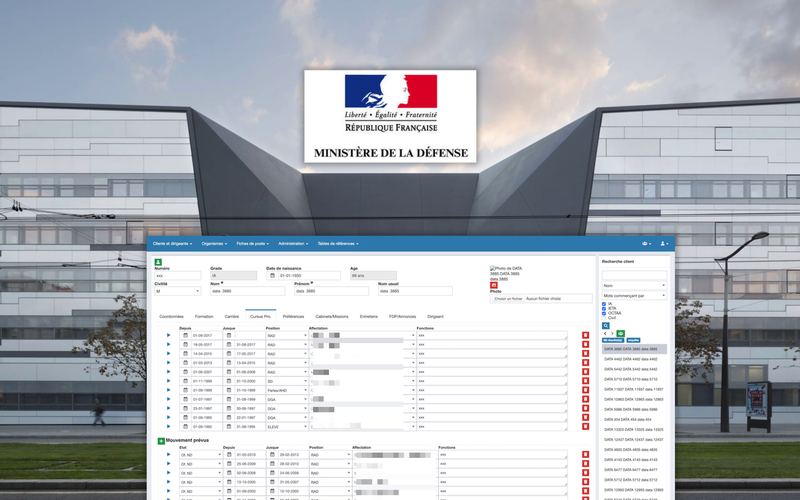 Business software · Major public-sector client
Redevelopment of business software for the French Ministry of the Armed Forces
 Web and mobile application
Tailorfin, a web and mobile wealth management application
 Business application
RE-GROUP, bespoke software for property development
These projects reflect very different needs, but a single approach: understand the business, design the right solution, integrate it into its environment and evolve it over time.
Technologies
Technical expertise serving the solution
Choosing a technology or an architecture is never an end in itself. It depends on the project, the technical environment already in place, the integrations required and the expected performance, but also on how the software will be maintained and evolved over time.
Our teams work across web, mobile, API and database environments, with technologies such as Ruby on Rails, React, React Native, Flutter, Node.js, Python and PHP. We choose the technology stack based on the real constraints of the project rather than systematically imposing one technology.
Development practices are also evolving with artificial intelligence. On some parts of a project, or for certain types of work, AI-assisted development approaches, sometimes likened to “vibe coding”, can deliver faster results. They are, however, used within a framework where architecture, code quality, security and maintainability remain under our teams’ control.
Existing systems
Taking over or redeveloping existing software
A software project does not always start from scratch. It can also mean taking over or modernising an existing application that has become difficult to maintain, too costly to evolve or no longer suited to new needs.
We can work on software developed by another team in order to understand how it works, assess its technical condition and define the best strategy going forward.
Depending on the context, this takeover can be used to:
Illustration: assessment carried out before a takeover.
- Fix malfunctions or stabilise the application
- Reduce technical debt
- Modernise the architecture or certain technology components
- Improve performance, security or maintainability
- Add new features
- Reconnect the software to new services or APIs
- Prepare a larger evolution without necessarily rebuilding everything
The aim is to preserve what works, identify what needs to change and give the software a sufficiently sound foundation to keep developing over the long term.
For the long term
Maintaining and evolving your software over the long term
4-hour guaranteed intervention time
Time to take charge of and intervene on an incident, according to the agreed service level.
We can provide maintenance and application maintenance and support for the solution after launch, whether it was developed by Idéematic or taken over from another team.
Depending on your needs and the agreed service level, we can offer a 4-hour guaranteed intervention time, corresponding to the time to take charge of and intervene on an incident.
For software we have developed, a corrective maintenance warranty applies for a period set out in the contract; evolutive maintenance then takes over.
This support can cover, in particular:
Ticket #2481
Resolved in 2 h 36 minIllustration: handling an incident within a 4-hour guaranteed intervention time.
- Fixing bugs
- Preventive and technical maintenance
- Updates needed for the application to run properly
- Adding new features
- Adapting to new business processes or practices
- Evolving interfaces and integrations
- Gradually improving performance, security and maintainability
This continuity preserves knowledge of the software and its context, while preventing it from deteriorating or gradually becoming difficult to evolve.
Frequently asked questions
How much does bespoke software cost?
The cost depends on the functional scope, the number of user profiles, integrations with the IT landscape, migration of existing data and security requirements. Each project is priced after an initial conversation and a scoping phase, which sets a precise scope and schedule.
How do you choose between off-the-shelf and bespoke software?
Off-the-shelf software is suitable when your needs are simple and widely shared. Bespoke software is justified when adapting to your processes, integrating with your IT landscape or being able to evolve the tool are important issues. The comparison table on this page summarises the differences.
How does building bespoke software work?
The project starts with scoping the need, continues with specifications, wireframes, technical choices and development, then testing, acceptance and go-live. Maintenance and enhancements then take over.
How long does it take to develop bespoke software?
From a few weeks to a few months, depending on the scope. The scoping phase sets a precise schedule.
With AI, do you still need bespoke software?
AI now makes it possible to build simple tools on your own. Bespoke software remains necessary when the project becomes complex: integration with the IT landscape, data volumes, business rules, security requirements, migration from existing systems and lifespan. We use AI to prototype and analyse data, and we integrate AI features when they add business value.
Who maintains the software after go-live?
Idéematic can provide maintenance and application maintenance and support, including for software taken over from another team, with a 4-hour guaranteed intervention time if needed. For software we have developed, a corrective maintenance warranty applies for a period set out in the contract, after which evolutive maintenance takes over.
Do you have a bespoke software project?
Building a new solution, replacing an existing tool, taking over an application or evolving your systems: tell us about your business need and let’s discuss the most relevant way to meet it.