

Idéematic
EN
Discuss your projectContact usContact

Business application · CRM

Bespoke CRM, designed around your sales organisation

Your opportunities, your sales rules, your management. Idéematic designs, develops and maintains bespoke CRMs for organisations whose sales follow-up does not fit into standard software: several subsidiaries, fine-grained access rights, stages specific to each business line.

Illustration: a pipeline shared by several subsidiaries, where each opportunity keeps its own sharing level.

Definition

What is a bespoke CRM?

A bespoke CRM is customer relationship management software developed for a specific organisation. Its data, stages, rights and integrations are designed around how it actually sells, instead of forcing teams to adapt to a generic tool.

The tool adapts to the company’s real workflows. Fields, stages and indicators reflect the business language used every day, so teams do not work around the software or multiply side spreadsheets.

It is a form of bespoke business application, focused on customers, contacts and opportunities.

Comparison

Off-the-shelf CRM or bespoke CRM?

Systematically setting bespoke CRM against SaaS CRM would be a strategic mistake. A “bad bespoke” solution — poorly scoped, undersized or insufficiently maintained — will always perform worse than a “good SaaS” solution that is properly configured and adopted by the teams.

SaaS remains suited to standard processes but, as the company becomes more structured, technical rigidity hampers agility and limits competitive differentiation.

To compare market solutions (in French): our selection of CRM software for SMEs and our guide to building a custom CRM.

Comparison between an off-the-shelf CRM and a bespoke CRM
Off-the-shelf CRM (SaaS)Custom CRM
Cost modelMonthly subscription (OPEX), affordable initial investment.Higher initial investment (CAPEX).
Roll-outFast.After scoping and phased development.
ProcessesStandardised sales processes.Fields, stages and indicators built on your real workflows.
Code and dataThe vendor’s software.Ownership of the code and control of the data.
MaintenanceProvided by the vendor (security, updates).Provided by the service provider, under an application maintenance contract.
Who is it for?Startups, service-sector SMEs, B2B businesses with standard processes.More structured organisations: multi-site groups, specific business rules, large volumes.

Features

What your CRM can include

A bespoke CRM starts from your uses. The CRM of KS Groupe, for example, brings together several complementary functions:

  • Centralisation of contacts, customers, stakeholders and opportunities
  • Multi-criteria search, advanced filters, saved searches and customisable columns
  • Tracking of activities, meetings, reminders, notes and attachments
  • User mentions and notifications to help information flow
  • Export of selected data to Excel
  • Customisable dashboard with lists and indicators
  • Geographical view of opportunities on a map
  • Initial import of existing data from CSV files

Beyond sales relationships

A bespoke CRM can handle much more specific needs. For Alsace Lait, for example, we designed a bespoke CRM for after-sales service and customer relations.

After-sales service

Customer follow-up such as after-sales service, meeting the exact challenges of managing complaints, support requests and malfunctions.

Site tracking

Site management designed specifically around the company’s business logic.

Field teams

Geolocation of technicians when they are on site.

Your business applications

Integration between the CRM and the company’s highly specific business applications.

Illustration: rights vary according to role, action and the opportunity’s sharing level.

Access rights

Access rights that fit your organisation

In a CRM used across a group, centralising data does not mean that every user should be able to access all the information.

For KS Groupe, the system was designed around fine-grained management of roles and scopes. Administrators, group or subsidiary management, sales management, sales teams and administrative profiles have different rights to read, create, edit, assign or share.

An opportunity can itself be private, limited to one subsidiary or become cross-entity when several group entities are involved. The main changes are logged: action taken, author, date, values before and after the change.

Pipeline

A pipeline that follows your stages, not a software vendor’s

The opportunity is one of the CRM’s central elements. Its tracking had to match the commercial realities of the group’s different business lines rather than a standard pipeline imposed by off-the-shelf software.

An opportunity can be created even before all the parties involved are known. It can then move through several states and milestones: creation, decision whether to proceed, study phase, intermediate stages, then a final or temporary outcome, for example won, lost, postponed or abandoned.

The CRM also makes it possible to assign a probability of success to an opportunity and track its potential revenue. For projects spanning several financial years, this amount can be spread over time to give a more realistic view of the sales potential.

Opportunities related to property development can, for example, be linked to an organisation structured into developments, buildings and lots.

Illustration: an opportunity tracked according to milestones specific to the business, with revenue spread over time.

Integration

A CRM integrated into your information system

A bespoke CRM can be designed on an “API-first” basis, making it easier to integrate into the existing ecosystem of ERP, site management tools, accounting software, marketing solutions or mobile apps. This approach reduces double entry, makes data flows more reliable and limits the risk of excessive dependence on a single supplier (vendor lock-in).

  • KS Groupe: authentication via the group’s Microsoft 365 accounts, two-factor authentication and access through the group’s VPN; a SIRET lookup API to pre-fill company details, and an address search service.
  • MyInvest: the existing CRM is not replaced. Groupe Vivialys’ partner extranet communicates with its Microsoft Dynamics CRM; approval takes place in the CRM, and the result is then sent back to the extranet.

See also: integrating your information system (ERP, CRM, API).

Approach

Our approach to building your CRM

  1. 1

    Audit your processes

    Initial audit of sales processes and mapping of real needs: entities, profiles, rights, stages.

  2. 2

    Scope the first release

    A precise specification for a first scope focused on business value, with wireframes to validate user journeys.

  3. 3

    Develop in cycles

    Features are delivered progressively so they can be presented, tested and adjusted during the project.

  4. 4

    Deploy and support

    Import of existing data, go-live and support for users during roll-out.

For the long term

Evolving your CRM

A bespoke CRM is a strategic digital asset but, without structured maintenance, it gradually loses performance and security.

Application maintenance and support covers bug fixing, adding features and adapting to changes in systems and technical environments.

The CRM can also include artificial intelligence features when they serve a concrete use, for example to:

  • Summarise meetings
  • Generate structured minutes
  • Automatically feed management dashboards
  • Prioritise opportunities based on customer history

Case studies

CRMs in production

See our case studies
KS Groupe headquarters in Strasbourg

Bespoke CRM · Multi-subsidiary

KS Groupe: a CRM shared by several subsidiaries

KS Groupe brings together several subsidiaries and departments whose activities, sales organisations and levels of access to information differ.

The future CRM therefore had to create a shared system of record without imposing the same way of working on everyone. Teams needed to share useful information, identify cross-entity opportunities and build a qualified contact database, while keeping each subsidiary’s own rules.

See the KS Groupe case study
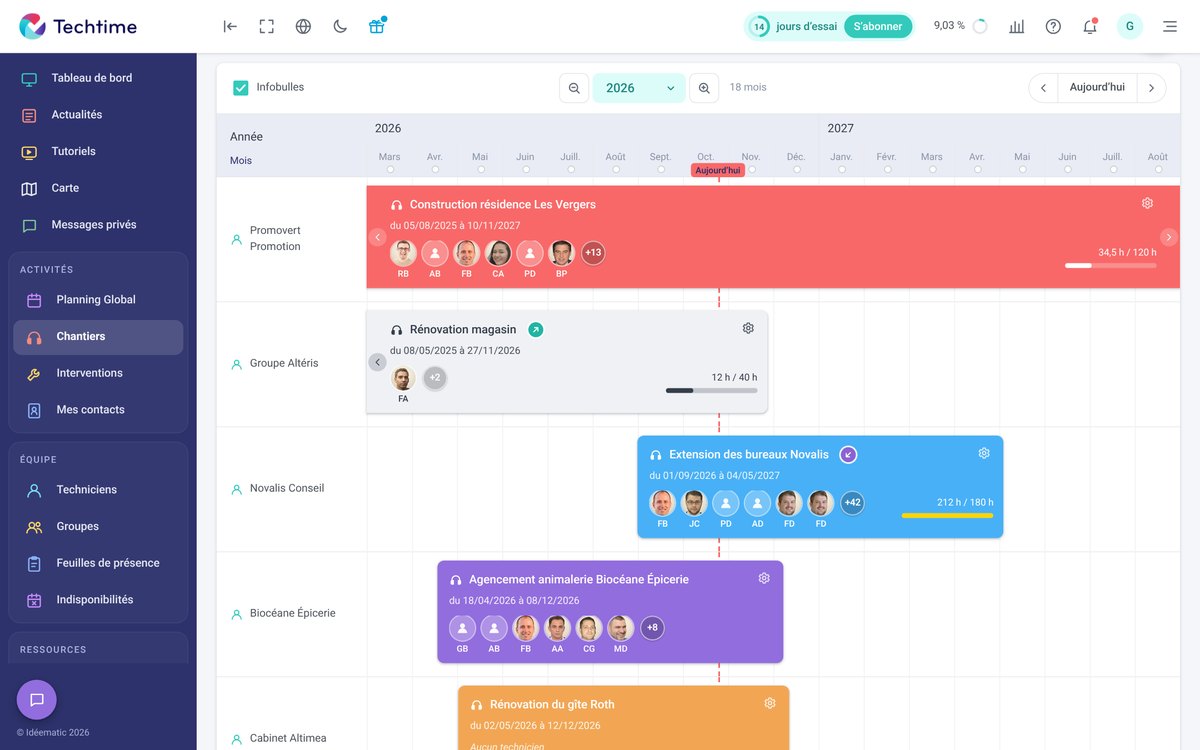
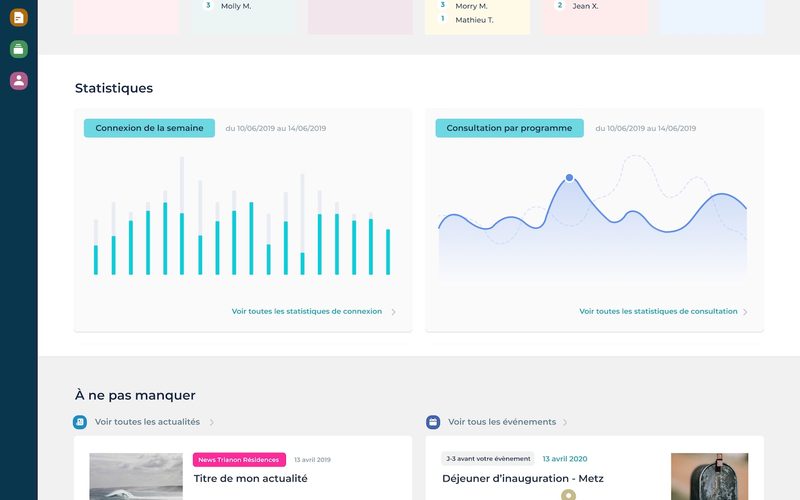
Planning of construction sites and interventions in the Techtime application

Business software · Web and mobile

Techtime: a CRM built into site tracking

Techtime, our site and intervention management application, has its own CRM to manage site history and customer interventions.

With its Contacts feature, the company manages the links between contacts and a customer’s different sites.

See the Techtime case study
MyInvest extranet dashboard

Partner extranet · Existing CRM

MyInvest: an extranet connected to the group’s CRM

When passing on a contact or placing an option, the partner enters their customer’s details directly. The request is then forwarded to the relevant account manager for processing.

MyInvest communicates in particular with the Microsoft Dynamics CRM and the Easyfolder DMS through web services and APIs.

See the MyInvest case study

Frequently asked questions

Bespoke CRM or off-the-shelf CRM: how to choose?

An off-the-shelf CRM suits standard sales processes: it can be rolled out quickly and the vendor handles maintenance. A bespoke CRM becomes relevant as the organisation becomes more structured: several subsidiaries, fine-grained access rights, stages specific to each business line or specific integrations. A “bad bespoke” solution, poorly scoped or poorly maintained, remains less effective than a good, well-adopted SaaS.

Can we migrate the data from our current CRM?

Yes. Existing data can be imported at the start. For KS Groupe, the initial import of existing data was planned from CSV files, with each company uniquely identified by its SIRET number to limit duplicates.

How do you manage rights in a multi-subsidiary group?

Through fine-grained management of roles and scopes. In KS Groupe’s CRM, each profile has different rights to read, create, edit, assign or share, and an opportunity can be private, limited to one subsidiary or cross-entity.

Can the CRM be used on mobile?

Yes. A mobile app can give field teams access to the CRM. In Techtime, technicians check their schedule on mobile and send their information back to the web platform.

Can AI be integrated into a bespoke CRM?

Yes, when it serves a concrete use: summarising meetings, structured minutes, automatically fed dashboards or prioritising opportunities based on customer history.

How much does a bespoke CRM cost?

A bespoke CRM requires a higher initial investment than a subscription, in return for ownership of the code and control of the data. Its cost depends on the number of entities and profiles, the business rules, the integrations, the data migration and the level of maintenance expected. We estimate it after scoping.

Does your sales follow-up not fit into a standard CRM?

Tell us about your organisation, your stages and your tools: together we will work out the right CRM for you.

Let’s talk about your CRMGet in touch