

Idéematic
EN
Discuss your projectContact usContact

Design

Software project scoping and design

Structuring needs, user journeys, priorities, specifications and costing before development. By the end of this phase, the project is no longer just an intention.

Groupe Quinze

Over 100 screens

A 190-page specification led to the definition of over 100 functional screens, formalising user journeys, user rights and business rules before development.

See the Groupe Quinze case study

RE-GROUP

63 functional templates

Scoping resulted in a detailed sitemap and 63 functional templates, covering the application’s main profiles and key moments.

See the RE-GROUP case study

When to scope

When should a software project be scoped?

Scoping, sometimes called product discovery, is the phase that precedes software development. It turns a need into a defined scope: users, journeys, business rules, data, priorities and costing, so that next steps can be decided on a reliable basis.

A software project deserves scoping as soon as the need has been identified but the solution, its scope or its priorities still need to be clarified. This stage is particularly useful when:

  • Several business functions or user profiles are involved in the project;
  • The needs expressed are numerous, sometimes contradictory or still hard to prioritise;
  • The software has to reproduce, simplify or transform existing business processes;
  • Business rules, access rights, data or integrations need to be defined;
  • Several technical or functional solutions are possible;
  • The budget or timeline makes it necessary to separate the essentials from what can be developed later;
  • The project needs to be precise enough for a reliable estimate of its design and development.

Scoping then makes it possible to test expectations against real-world use, the company’s constraints and the project’s feasibility. It avoids locking in a solution too early that would only partly solve the original problem.

From need to project

From business need to a project ready for development

The starting point is not always a list of features. It may be a process that has become too complex, information scattered across several tools, a task still done manually or simply an idea that needs to be tested against real-world use.

Scoping means laying these elements out, understanding who will use the future software and in what context, then turning the needs identified into concrete choices. Some requests are grouped together, others simplified, deferred or set aside. Priorities gradually become clearer along with the business rules, user journeys, data to be handled and the constraints of the information system.

By the end of this phase, the project is no longer just an intention. Its scope is defined clearly enough to decide on next steps, estimate the development and organise delivery in stages if necessary.

Needs

Understanding the needs before defining the solution

Before drawing screens or choosing a technology, we try to understand how the work is actually done today. Workshops bring together the people involved in the project to compare expectations, constraints and uses. In particular, we look at four questions:

Who will use the software?

Profiles, responsibilities and access levels are not always the same.

How is the work done today?

We map out the steps, the tools used, the information exchanged and any re-keying.

What rules must be followed?

Approvals, calculations, exceptions, rights, dependencies between actions or regulatory constraints can strongly shape the future software.

What really needs to change?

A request phrased as a feature can sometimes reveal a wider problem with processes, organisation or the flow of information.

This understanding avoids treating the initial request as a ready-made answer. It provides a sounder basis for then designing the journeys and features that are genuinely useful.

Scoping a project well starts with working out what is genuinely worth building.

Features and user journeys

Turning needs into features and user journeys

Once uses and business rules have been clarified, the project can be translated into concrete software behaviour. We define the main features, each person’s role, the possible actions and the information needed at each step.

User journeys then make it possible to check how these elements fit together in practice. They highlight unnecessary steps, friction points, missing approvals or special cases that might otherwise emerge too late during development.

Depending on the project, this work may take the form of usage scenarios, sitemaps, functional diagrams or initial wireframes. The aim is to make the behaviour tangible enough to discuss, adjust and approve it before committing to technical delivery.

Usage scenariosSitemapsFunctional diagramsWireframes

This phase also makes it possible to separate the functions essential at launch from those that can be added later.

Approve

Designing bespoke software: validate before you develop

Not every uncertainty needs the same level of representation. Scoping can remain highly functional or go as far as a usable version of the future software when that genuinely helps a decision to be made.

Wireframes

To validate the organisation and user journeys, wireframes are often enough to position the information, actions and the sequence between screens.

A clickable prototype

To test an interface against real-world use, a clickable prototype can make the project much more concrete and quickly reveal misunderstandings or choices to revisit.

A prototype or a POC

To remove a technical uncertainty, a prototype or a POC can also be used to test an integration, a specific process or the feasibility of a feature before including it in the final scope.

The Groupe Quinze project illustrates this upfront design approach: a 190-page specification led to the definition of over 100 functional screens, formalising user journeys, user rights and business rules before development.

The point is not to produce detailed mock-ups every time. It is to choose the simplest way to check the key assumptions before they become costly to change.

Vibe coding prototypes→

Data and IS

Preparing data, architecture and integrations

Software cannot be designed independently of the data it has to handle or the tools it will need to exchange data with.

During scoping, we identify the main information to be managed, its origin, its level of sensitivity, the associated rights and any dependencies on other applications.

We also study the connections needed with the information system: CRM, ERP, business software, external services, e-signature, payment and messaging tools, or partner APIs.

These elements help anticipate structural choices before development: data organisation, responsibilities between applications, authentication constraints, volumes to process or real-time exchange needs.

The aim is not to lock in the entire technical architecture prematurely, but to secure the decisions that can directly affect the project’s scope, cost or feasibility. See also: ERP, CRM and API integration.

Scope

Defining a realistic scope, priorities and budget

As the project takes shape, not all the features envisaged have the same priority. Some are essential for the software to work; others can be postponed without undermining its initial value.

Scoping is used to organise these choices. We bring together business needs, technical constraints, dependencies between features and the available budget to build a coherent scope. Depending on the project, this may lead to defining:

  • A core feature set essential at launch;
  • Features to be added in a second phase;
  • Successive development batches;
  • An MVP when it genuinely makes it possible to test a use or a model;
  • Elements deliberately left out because their cost or complexity is not justified at this stage.

Once these trade-offs have been made, the project can be estimated on a much more reliable basis. The costing then rests on an understood, documented scope, rather than on a mere list of still-ambiguous intentions.

Founders and project owners

Do you have an idea for an app or software?

We also support startups and companies that want to bring an application or software to market, from the idea that needs scoping through to the first product.

Whether you are a startup, an SME, an IT department or a project owner, you often need to bring an idea to life quickly. You may want to test a product intuition, present a concept to partners or investors, align internal stakeholders or check the consistency of a future business tool.

Vibe coding makes it possible to move faster in this early phase. Using AI, an interactive prototype can be produced much more quickly than in a conventional development cycle.

We use vibe coding as an accelerator for product thinking, not as a gimmick that replaces expertise.

Case studies

Projects scoped before being developed

See our case studies
Building under construction and cranes

Business application · Scoping

RE-GROUP: scoping complex business software before development

RE-GROUP wanted to turn a land search process into a business application able to centralise files, automate their analysis and coordinate the different parties in a property development project.

Before moving on to development, we translated this complex way of working into user journeys, data, calculations, access rights, documents and approval workflows. Scoping resulted in a detailed sitemap and 63 functional templates, covering the application’s main profiles and key moments.

The user journeys were then formalised as functional test scenarios describing the user context, the actions carried out and the expected result.

This work turned numerous, interlocking business rules into a specification precise enough to design, develop and then test the application.

See the RE-GROUP case study
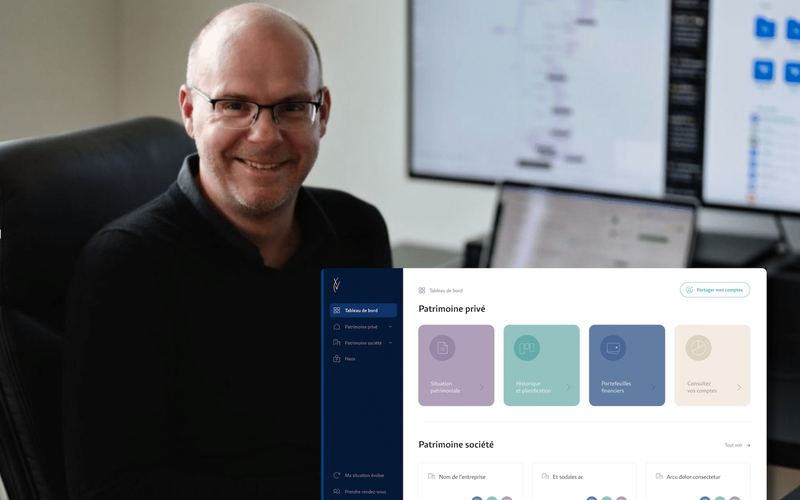
Interface of the Groupe Quinze wealth management platform

Wealth management platform · Design

Groupe Quinze: over 100 screens defined before development

Groupe Quinze wanted a digital environment able to centralise the information and services involved in supporting its clients’ wealth management.

A 190-page specification led to the definition of over 100 functional screens, formalising user journeys, user rights and business rules before development.

See the Groupe Quinze case study

After scoping

After scoping, moving into development under the right conditions

Once the project has been clarified, the main decisions are no longer put off until development. The team has an understood scope, clear priorities and a sufficiently precise view of how things are expected to work.

Development can then start on a sounder footing. Discussions are more efficient, trade-offs are better prepared and the risk of discovering a business rule, a dependency or a poorly defined feature too late is reduced.

When we continue the project with you, the work done during scoping serves directly as the basis for designing and developing the bespoke software. The knowledge gained about uses, constraints and functional choices is retained throughout delivery.

Scoping is nonetheless useful in its own right: it should enable an informed decision, whether that means launching development, reducing the scope, phasing it or revisiting certain choices before going further.

Frequently asked questions

What is software project scoping?

It is the phase that precedes development. It turns a need into a defined scope: users, journeys, business rules, data, integrations, priorities and costing. By the end of it, the project is no longer just an intention and next steps can be decided on a reliable basis.

Scoping and product discovery: what is the difference?

Product discovery mainly refers to exploring a product: understanding the problem and the users and validating assumptions, often with a prototype. Scoping covers this work and goes as far as the scope, priorities, architecture and costing of the development.

Do you need a specification to get started?

No. The starting point is not always a list of features: a process that has become too complex, scattered information or an idea to test against real-world use is enough. If you already have a specification, notes, diagrams or mock-ups, they serve as the basis for the work.

What does a scoping deliverable contain?

Depending on the project: usage scenarios, a sitemap, functional diagrams, wireframes or a prototype, the business rules and data to be managed, the integrations to plan for, a prioritised scope and a development estimate.

Can a prototype be built before development?

Yes. Wireframes are often enough to validate the organisation and user journeys. A clickable prototype lets you test the interface against real-world use, and a prototype or POC can remove a technical uncertainty. We also build vibe coding prototypes.

Do you support startups and project owners?

Yes. We support startups and companies that want to bring an application or software to market: scoping the idea, prototyping, defining an MVP when it genuinely makes it possible to test a use or a model, then development.

Does scoping commit you to the rest of the project?

Scoping is useful in its own right: it should enable an informed decision, whether that means launching development, reducing the scope, phasing it or revisiting certain choices before going further.

A project to scope?

Tell us about your needs, your users and your constraints: we will propose the right scoping approach.

Let’s talk about your projectGet in touch