
Modernise
Takeover and modernisation of existing software
Software can still work while becoming hard to maintain, secure or evolve. We start by auditing the existing system to understand its architecture, dependencies, data and the business uses to preserve.
This analysis lets us choose the right pathway: taking over the code, partial redevelopment, migration or a complete rebuild, without starting from scratch when there is no reason to do so.
French Ministry of the Armed Forces
Six months
Deadline for the complete redevelopment of business software built in Microsoft VB6, whose Oracle data was migrated to PostgreSQL.
See the case studyINSA Strasbourg
From Java software to the web
A complete rewrite of STEPS to make it accessible from a browser, while keeping the functional richness of the Java version.
See the STEPS case studyWhen to modernise
When should existing software be taken over or modernised?
Software modernisation means updating an existing application that has become hard to maintain or evolve: targeted fixes, gradual replacement of certain parts or a complete rebuild. It keeps the data, business rules and integrations that still have value.
Software can keep working while gradually becoming hard to maintain, secure or evolve. Over time, certain technical constraints can slow down development, increase the risk of regressions or limit the scope for change.
Several warning signs should raise the alarm:
- New features become slow, costly or risky to develop
- Some technologies, libraries or dependencies are no longer maintained or complicate security updates
- Bugs multiply, and a change in one part of the software has hard-to-predict effects elsewhere
- The architecture is no longer suited to data volumes, the number of users, new integrations or current uses
- The code has become hard to understand, test or take over, especially after several years of changes or a change of team
- The application no longer adequately meets business processes or users’ expectations
Data, APIs and connections to the information system can also make an abrupt replacement particularly risky. Before deciding on a redevelopment, it is therefore essential to identify what really needs to be replaced, modernised or kept.
A software audit assesses the blocking points, the components that are still reliable and the critical dependencies. This analysis then makes it possible to choose a suitable takeover strategy, rather than launching a complete rebuild on principle.
Pathways
Targeted takeover, partial redevelopment or complete redevelopment?
The strategy depends on the actual state of the software, its architecture and the expected developments. Three approaches can be considered:
Targeted takeover
The foundation remains reliable, but some components, dependencies or features need to be fixed or modernised.
Partial redevelopment
Some parts of the application have become too restrictive. They can be replaced gradually while keeping the components that still suit business uses.
Complete redevelopment
The existing system no longer allows development under the right conditions. The new application keeps the business rules, data and integrations that still have value, without needlessly reproducing the limitations of the old software.
The choice between these pathways is based on the analysis of the existing system, but also on service continuity constraints, the acceptable level of risk and the software’s development goals.
Takeover
Taking over software developed by another team
Changing provider or technical team does not mean the software has to be rebuilt. We can take over an application without having been involved in its original design, provided we start by rebuilding a reliable understanding of how it works.
In particular, we examine the source code, the technologies and dependencies used, the data structure, the connected APIs and services, the hosting environments, the deployment procedures, the tests and the available documentation. Where documentation is incomplete, analysing the code and how the application actually behaves makes it possible to gradually identify the well-understood areas, critical dependencies and points of attention.
When the state of the application calls for a deeper analysis, a technical audit provides an objective view of weaknesses, technical debt and risks before deciding on the work to be done.
The takeover then consists of securing the ability to maintain and evolve the software: reproducing the necessary environments, checking the main business journeys, making deployments reliable and documenting what the new team needs.
This work makes it possible to gradually regain control of the project before deciding on the fixes, modernisation or redevelopment that are truly necessary.
- 1
Understand the existing system
Code, data, APIs, environments, deployments, tests and documentation. A technical audit provides an objective view of weaknesses where necessary.
- 2
Secure maintenance
Reproduce the environments, check the main business journeys, make deployments reliable, document.
- 3
Decide on the work
The fixes, modernisation or redevelopment that are truly necessary, once control of the project has been regained.
Without interruption
Modernising gradually without disrupting the business
When software is used every day, its redevelopment cannot always wait until a complete new version is ready. We can then organise the transformation in stages, defining which components or features to take over first.
The old and new systems can coexist temporarily. Data, interfaces or features are migrated gradually, then validated before each new switchover. This approach limits risks, preserves essential uses and allows a problem to be fixed quickly without calling the whole project into question.
How the work is split depends on the existing architecture, the dependencies between modules and operating constraints. The aim is to modernise the software while maintaining service continuity for its users as far as possible.
Data and IS
Preserving existing data and integrations
In business software, a key part of the value lies in the data accumulated over the years and in the exchanges established with the rest of the information system. Preserving them must therefore be planned from the start of the redevelopment.
We map the databases, APIs, exchanged files, external services and authentication mechanisms used by the application. For each element, we determine what can be kept as is, what needs to be adapted and what deserves to be replaced.
Data migration is prepared and tested before the switchover. Mappings between old and new models are checked, as are data integrity and the correct operation of interfaces with other tools.
This approach makes it possible to modernise the software without losing its history or breaking the exchanges on which its users and the company’s other applications depend. See also: ERP, CRM and API integration.
Business application
Modernising a business application without losing essential uses
Modernising a business application must not undermine the uses and features that still meet users’ needs. Behind an interface that may look dated there are often years of business rules, journeys, automations and special cases that contribute directly to how the company operates.
Before changing interfaces or processes, we identify:
- The journeys actually used
- Business rules and access rights
- Automations
- Exceptions that are essential to the business
We thus separate what deserves to be kept from what can be simplified or rethought.
The modernisation can then be thorough on the technical side without needlessly imposing new ways of working. When certain journeys need to change, they are redesigned around how the teams actually work and validated on representative scenarios before go-live.
The aim is not to reproduce the old software identically, but to preserve its business value while removing the constraints that limited its development.
Case study
French Ministry of the Armed Forces: redeveloping existing business software
For the Conseil Général de l’Armement (CGARM), Idéematic carried out the complete redevelopment of career-management business software. The existing application had been developed in Microsoft VB6 and relied on an Oracle database.
The aim was to replace it with a new web application, while keeping the data and the features essential to users.
The project began with an analysis of the existing solution and its data model. The information in the old Oracle database was extracted, reprocessed and then adapted to the new PostgreSQL model. In parallel, the business features were redeveloped on the new application foundation, including an internal search engine and several optimisations to make the application faster and simpler to use.
The redevelopment had to be completed on a particularly tight schedule, with a six-month deadline. After go-live, Idéematic continued its support with evolutive maintenance of the application and user assistance.
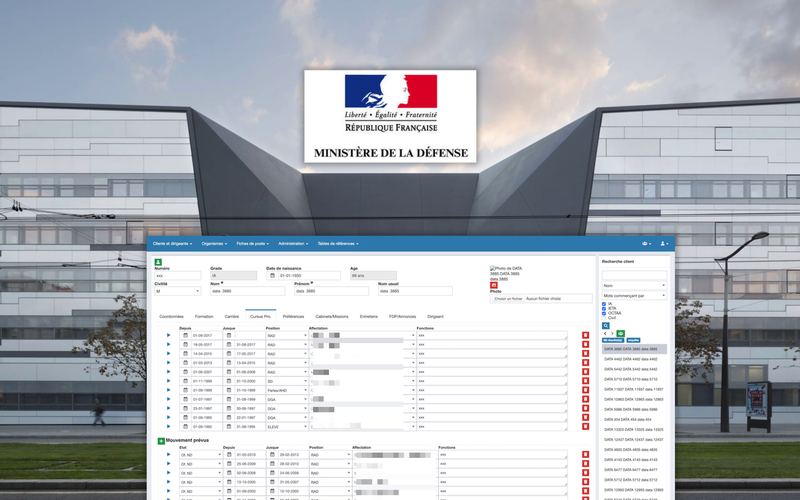
This project shows what redeveloping business software involves:
- Understand the existing system
- Preserving the useful data
- Rebuilding on a new technical foundation
- Ensuring continuity after the migration
For the long term
After modernisation, keep evolving the software
The go-live of redeveloped software does not mark the end of the project. The first months confirm how it works in real conditions of use, deal with any adjustments and support the changes that emerge after the switchover.
When we continue to support you, we retain the knowledge gained during the takeover and modernisation. This continuity makes it easier to diagnose incidents, apply fixes and technical updates, and develop new features.
Our team also takes the initiative. User feedback, new business needs and actual use of the application help identify new areas for improvement: simplifying certain journeys, improving the user experience, automating tasks, adding features or adapting to new internal processes.
The software can thus continue to evolve on a foundation that is now under control, with a team that knows its architecture, business rules and integrations, and that can support its improvement over the long term.
This support can then become part of application maintenance and support to organise corrective maintenance, enhancements and technical monitoring of the software.
 Client testimonial
Well-suited and highly effective support
Idéematic fully met our expectations even though both the financial and technical frameworks were particularly constrained.
Case studies
Related case studies

Frequently asked questions
What is software modernisation?
It is the modernisation of an existing application that has become hard to maintain, secure or evolve. Depending on its state, it takes the form of a targeted takeover, a partial redevelopment or a complete redevelopment, keeping the data, business rules and integrations that still have value.
Do you have to rebuild everything to modernise software?
No. When the foundation remains reliable, a targeted takeover is enough: certain components, dependencies or features are fixed or modernised. Parts that have become too restrictive can also be replaced gradually. A complete redevelopment is reserved for cases where the existing system no longer allows development under the right conditions.
Can you take over software developed by another provider?
Yes. We start by rebuilding a reliable understanding of how it works: source code, dependencies, data, APIs, hosting, deployments, tests and documentation. A technical audit provides an objective view of the risks where necessary, before deciding on the work to be done.
Can software be modernised without interrupting the business?
Yes, by organising the transformation in stages. The old and new systems can coexist temporarily: data, interfaces or features are migrated gradually, then validated before each new switchover.
What happens to the data during a redevelopment?
It is mapped from the start of the project, along with the APIs, exchanged files and connected services. The migration is prepared and tested before the switchover: mappings between old and new models, data integrity and the operation of interfaces with other tools.
How long does a software redevelopment take?
It depends on the state of the existing system, its architecture, the volume of data and the pathway chosen. For example, the complete redevelopment of the French Ministry of the Armed Forces’ business software, from VB6 and Oracle to a PostgreSQL web application, had a six-month deadline.
Redevelopment or application maintenance: what is the difference?
Redevelopment transforms the software: it replaces or modernises all or part of the existing system. Application maintenance and support then organises its corrective maintenance, enhancements and technical monitoring over the long term.
Should your software be taken over, redeveloped or simply improved?
Is your software showing its limits, but the right approach is not yet clear? We can analyse the existing system with you, identify what deserves to be kept and determine whether it should be taken over, modernised or redeveloped more thoroughly.