
Web application · Technologies
The web and mobile technologies we use
Once we have identified all your needs with you, we select the most suitable technologies to develop your web or mobile application. As keen advocates of open source, we use them every day to build tomorrow’s solutions for you.
Definition
What are web development technologies?
Web development technologies are the languages, frameworks, databases and tools used to build a web application: the back end (server, business logic, APIs), the front end (interface in the browser), the database, and the tools that test and deploy the code.
There is no best technology in absolute terms: the right one is the one that meets your needs, will still be maintained in ten years and that other developers will be able to take over. Our choices serve our bespoke web applications, mobile apps and business software.
Architecture
How a web application fits together
A web application stacks several layers. The interface displays the screens, on a computer or phone; the server applies the business rules; the database stores the information; an API makes everything communicate, including your other software.
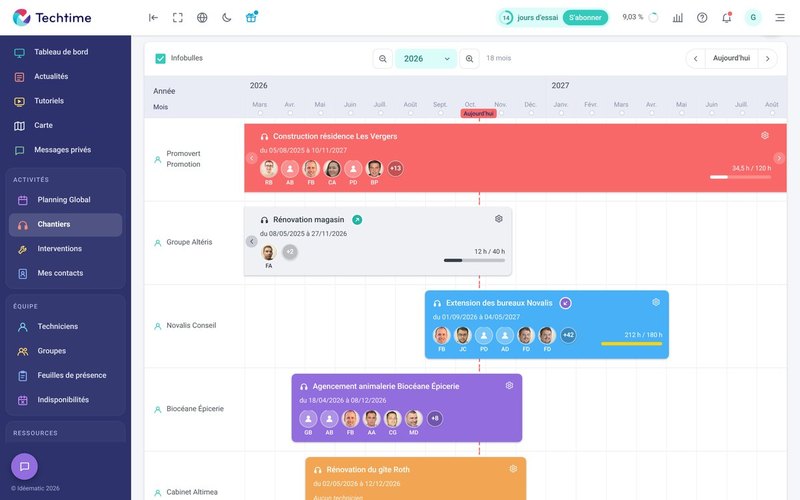
The same API often serves both the web application and the mobile app, as with the Techtime software: React JS for the web client, React Native for mobile, Ruby on Rails on the server side.
Discuss your projectA typical architecture: each project assembles the building blocks it needs.
Our core stack
The technologies we use every day
A tight core stack that the whole team masters: this is what guarantees the quality of your applications and the ability to take them over.
Ruby on Rails
Our reference framework for web applications and APIs, driven by our Ruby on Rails agency.
React JS
The rendering engine of our web interfaces, for fast, responsive applications. Find out more.
React Native
A single codebase for iOS and Android, developed by our React Native agency.
PostgreSQL
Our default relational database, robust and open. Find out more.
Automated tests
RSpec, Cucumber and Cypress check the code at every change, to avoid regressions.
Controlled deployment
Capistrano and written procedures to go live without interruption, on our hosting or yours.
All technologies
Technologies by area
Each name links to its definition in our digital glossary.
Back end
Mobile
React Native, for iOS and Android apps.
Databases
PostgreSQL, MySQL, MongoDB, Redis.
Testing and deployment
E-commerce and search
Spree Commerce for online commerce, Sphinx for indexing.
We also maintain existing applications built with Backbone JS, ExtJS, jQuery, Underscore JS or Meteor JS : a technical audit comes before taking them over or their modernisation.
Our criteria
How we choose a technology
The choice is made during scoping, with you, according to four criteria. It is explained and documented.
Suited to your needs
A real-time platform, a catalogue, a business tool: the technology follows the use, not the other way round.
Long-lasting
An active community, regular updates, a clear roadmap.
Maintainable
Readable, tested code that other developers will be able to take over.
Consistent with your IT systems
Compatible with your software, your teams and your hosting.
Case studies
These technologies in production
Applications we have developed and continue to evolve.


Frequently asked questions
What are the best technologies for web development?
There is no single one. The right technology meets your needs, remains maintained over time and can be taken over by other developers. For most of our applications, we use Ruby on Rails, React, React Native and PostgreSQL.
Why do you use Ruby on Rails?
Ruby on Rails makes it possible to develop robust web applications quickly, with conventions that make the code readable and easy to take over. We use it every day for business applications, platforms and APIs.
Why favour open source?
Open-source technologies do not lock your application into a vendor, are maintained by large communities and involve no licence fees to use.
Can you take over an application written in an older technology?
Yes. We maintain applications built with Backbone JS, jQuery, ExtJS or PHP. A technical audit comes before the takeover, then we propose to maintain or modernise it.
Which database should you choose?
We use PostgreSQL by default for structured data, MySQL depending on what already exists, Redis for caching and queues, and MongoDB for certain document storage needs.
How do you test and deploy applications?
The code is covered by automated tests (RSpec, Cucumber, Cypress) and released using tooled deployment procedures, such as Capistrano, to deliver without regressions.
A project, a technical question?
Tell us about your project or your existing application: we will advise you on the most suitable technologies.