
Websites and platforms · E-commerce
Bespoke e-commerce website, connected to your information system
Branded online shop, ordering portal for your business customers, multilingual catalogue: we develop e-commerce websites that apply your sales rules and exchange data with your ERP, your sales management and your stock.
Definition
What is a bespoke e-commerce website?
A bespoke e-commerce website is an online shop developed for a company, rather than configured from a standard solution. It applies its sales rules, catalogue, prices, customers, stock and delivery, and exchanges data with its information system: ERP, sales management, CRM.
Building an online shop is a development project whose aim is to sell your products or services. In many respects, you face the same questions as for a physical shop: positioning, catalogue, stock management, shop window, invoicing, payment. It is a bespoke web platform project in its own right.
B2C and B2B
The e-commerce websites we develop
For brands, manufacturers and networks that sell online to consumers and businesses alike.
Branded online shop (B2C)
A shop window that conveys your world and a carefully designed purchasing journey, with the back office to match: catalogue, orders, invoices, notifications.
B2B ordering portal
Your business customers, resellers or outlets order online, with their terms, their habits and your production or delivery constraints.
Multilingual and multi-shop catalogue
Several languages, shops or brands managed from a single tool, with separate environments.
Examples: the shop of Pillivuyt, the multilingual, multi-shop site of Bernardaud, or the extranet of Bagelstein, where outlets place their orders, which are then passed on to the central kitchens.
Information system
A shop that communicates with your tools
An isolated shop forces you to re-key: product sheets, stock, orders, customers. Connecting the site to your information system removes this double entry and the errors that come with it.
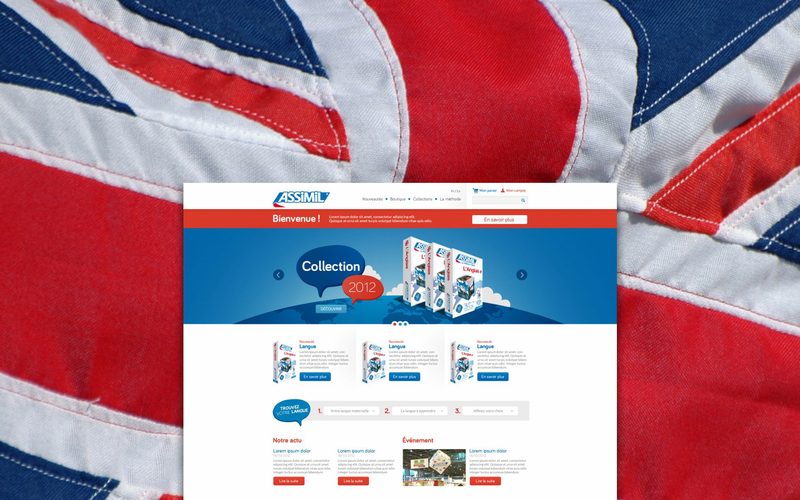
For Assimil, the shop had to communicate with several tools already used to manage products, stock and product information. These ERP, CRM and API integrations are planned from the specification stage.
Discuss your e-commerce projectThe most common exchanges; every project has its own.
Comparison
Bespoke or standard solution?
A standard solution suits a simple catalogue. Bespoke is justified when selling online depends on your rules and your tools.
| Standard solution (Prestashop, Magento…) | Bespoke | |
|---|---|---|
| Catalogue and prices | Simple catalogue, public prices. | Customer-specific prices, sales rules specific to your business. |
| Links with IT systems | Existing exchange modules, if your tool is a common one. | Exchanges designed for your ERP, stock and CRM. |
| Purchasing journey | The solution’s own, customised through the theme and modules. | Designed for your customers: consumers, businesses or both. |
| Enhancements | Limited by the solution and its modules. | According to your needs, without depending on a vendor. |
| Getting started | Fast for a standard need. | Prior scoping, then successive deliveries. |
We also work with market solutions, such as Prestashop for the website of Cornerluxe : scoping lets you choose with full knowledge of the facts.
Approach
The stages of an e-commerce project
The scoping breaks down all your needs: you keep full control of your online sales project.
- 1
The project presentation
Context, challenges, products, objectives and target audiences.
- 2
The sitemap and user journeys
Sections, pages and pathways, as clear as a well-laid-out shop.
- 3
The style guide and mock-ups
Usability, identity, wireframes, mock-ups and front-end integration.
- 4
The features
Front office: shop, search, basket. Back office: catalogue, orders, stock, users.
- 5
The technical specifications
Customer area, payments, promotions, loyalty and exchanges with your information system.
- 6
Hosting and maintenance
Hosting sized for your traffic, monitoring, corrective and evolutive maintenance.
Case studies
E-commerce websites for demanding brands
Manufacturers, publishers and fashion houses entrust us with their online sales, from design to maintenance.


Existing shop
Does your e-commerce site already exist?
An online shop is software: it is maintained, fixed and evolves with your needs.
Take over
Was your site developed by another team? We carry out atechnical audit before taking over its maintenance, as with the online shop of Molli.
Maintain and evolve
Fixes, enhancements and monitoring over the long term, with response levels defined together.
Redesign
When the shop no longer keeps up, a redesign starts again on lasting foundations without losing your content, customers or orders.
Frequently asked questions
Bespoke e-commerce site or a solution like Prestashop or Shopify?
A standard solution suits a simple catalogue sold at public prices. Bespoke is justified when you have customer-specific prices, your own sales rules or significant exchanges with your ERP, stock and CRM. Scoping helps you decide.
Can the site be connected to our ERP and stock management?
Yes. Products, prices, stock, orders and customers can flow between the shop and your information system, as for Assimil, whose shop communicates with several management tools.
Do you develop B2B e-commerce sites?
Yes: ordering portals for your business customers, resellers or outlets, with their terms and your production or delivery constraints, like Bagelstein’s ordering extranet.
Can you take over our existing online shop?
Yes. We start with a technical audit, then provide corrective and evolutive maintenance, as for Maison Molli’s shop.
Which technologies do you use for e-commerce sites?
Mainly Ruby on Rails, with for example Spree Commerce for Pillivuyt. We also use solutions such as Prestashop or WordPress when they fit.
Can you host and maintain the site?
Yes. Hosting is sized according to expected traffic and the size of the shop, with monitoring and corrective and evolutive maintenance.
An e-commerce project?
Tell us about your catalogue, your customers and your management tools: we will propose a suitable approach, from scoping to launch.