
Réalisation · Scoping & design
Alsace Lait, from workshops to a customer service CRM specification
Alsace Lait wanted to replace its after-sales database with a CRM bringing together logistics, consumers, quality and farm supplies. Before any development, Idéematic led the scoping and design phase: workshops with the teams, site map, more than 100 screens designed and a complete specification.


In brief
Alsace Lait
Idéematic ran the workshops, designed the wireframes and wrote the specification. The development of the CRM, subsequently entrusted to Idéematic, will be presented in a future case study.
The project’s mock-ups are confidential: the views shown on this page are wireframes reconstructed from them, with fictitious data.
- Business
- Dairy products, customer and consumer after-sales, farm supplies for producers
- Our involvement
- Scoping & design
The context
A customer service team that had outgrown its tool
Alsace Lait sells its dairy products to retail chains, answers consumers every day and sells farm supplies to milk producers. Its after-sales teams worked from an Access database, supplemented by spreadsheets and email inboxes: the information was there, but it was hard to use, especially for marketing and sales.
The company wanted a CRM that would bring three activities together in a single tool:
- logistics and quality after-sales, for disputes with customers and carriers
- consumer after-sales, for complaints, parcel shipments and exchanges with the public
- farm supplies, for following up producers, visits and delivery rounds
Before choosing a solution and starting development, Alsace Lait entrusted us with the scoping and design phase. Our role is much like an architect’s: understand how people live in the house, draw up the plans, and only let building work begin once every room has been thought through.
The workshops
Letting the business speak before writing a line of code
The project began with workshops alongside a working group of key Alsace Lait staff: logistics, consumer service, quality and farm supplies. For each activity, we described the current situation as people actually experience it, the information they handle, their day-to-day frustrations, then the improvements they expected.
These discussions brought out what a specification written in isolation never reveals: a closed dispute that must be able to become active again, customer data that must remain mastered in the ERP, producer visits that follow their own logic of priority. They also helped anticipate an often underestimated challenge: getting users on board with their future tool.
The site map
A clear structure for three activities
Based on the workshops, we drew up the CRM’s site map: a public area limited to signing in, and a private area organised into modules, one per activity, complemented by dashboards, statistics and a settings module reserved for administrators.
Each user profile was defined with its access rights, from administrator to read-only, and each need was written as a use case: more than a hundred in total, written from the point of view of the person who will use the screen.


The wireframes
More than 100 screens designed before any development
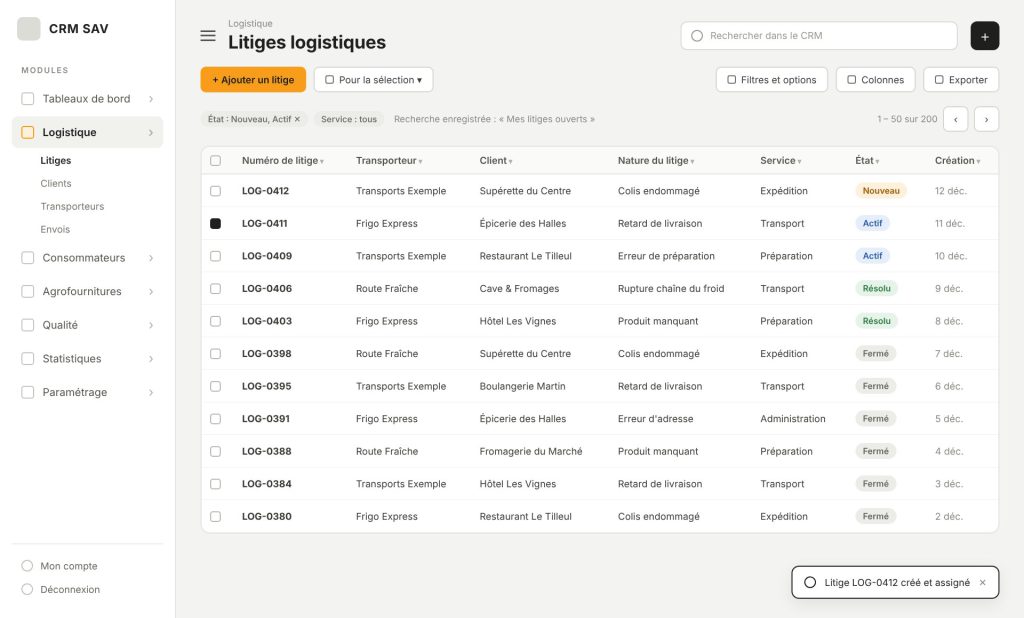
The use cases then took shape as wireframes: functional mock-ups, without visual design, that show what each screen contains and how users move from one to the next. Lists, record pages, creation forms, confirmation dialogs: more than 100 screens were designed, module by module, and numbered so they could be referenced in the specification.
Wireframes are the best time to change your mind. Moving a field or removing a screen then takes only a few minutes; the same change, once the application has been developed, is counted in days.
The shared principles
The same habits throughout the CRM
So that the tool is quick to learn, the screens share common principles, defined once and for all: a global search available everywhere, a quick-create button, lists where everyone chooses their own columns, filters that can be saved and reused, export of results and bulk actions on a selection.
A user who knows the logistics dispute list already knows how to use the consumer complaints list or the producer list.
Dispute handling
A life cycle designed with the teams
Each dispute follows a sequence of statuses agreed in the workshops, from creation to closure, with the option to reopen it. Information already known elsewhere is not re-keyed: on creation, the customer, the delivery and the lines concerned are filled in from the ERP.
Around each dispute, the team finds its full history: actions to be taken, assigned to a person, comments, documents and the emails exchanged, with reply templates prepared in advance.
Monitoring
A dashboard that everyone builds for themselves
Rather than a fixed dashboard, each user builds their own. They add lists from their saved searches and create their own indicators, choosing what should be counted or added up.
Statistics complete this monitoring, with configurable reports sent automatically at the chosen frequency.

In the field
From producers to delivery rounds
The farm supplies module was designed for the field: one record per producer bringing together orders, visits and exchanges, a list of visits to schedule according to their priority, and delivery rounds shown on a map, with a suggested route and the option to reorder the stops.
Producers can be notified by text message or email as a round approaches.
The interfaces
The CRM at the heart of the information system
A useful CRM does not work in isolation. The design phase listed every exchange with the tools already in place: the ERP, which remains the reference for customers and orders, the express carrier, the email and text message platforms, the dairy management software, the testing laboratory, mapping and the carriers’ portals.
For each one, the specification sets out the data exchanged and how often, for example overnight imports from the ERP whose success can be checked directly in the application.

The technical response
Choices settled at the design stage
The specification does not stop at the screens. It also sets the security and compliance requirements:
- sign-in with an email address, a strong password and two-factor authentication
- sessions that expire after a period of inactivity
- GDPR compliance: strictly necessary data, retention periods, exercise of rights
The chosen technical environment is based on Ruby on Rails and PostgreSQL, with containerised hosting (Docker, Kubernetes), a scalable infrastructure ready for the features already planned, such as real-time order tracking or a future online ordering site.
The specification
A document that commits and reassures
All this work leads to a complete specification: a reminder of expectations, an assessment of the current situation, the site map, profiles, use cases, cross-cutting features, interfaces, security, and the wireframes as a reference. It was versioned: the second version incorporates Alsace Lait’s feedback, with every change still visible compared with the first.
For the company, it is a document it owns. It makes it possible to estimate the project on a precise basis, to compare providers if it wishes, and to start development with no grey areas.
What came next
From plans to building work
Alsace Lait then entrusted us with the second phase: building the custom CRM we had designed together. That next stage will be the subject of a future case study.
A software project is often decided before the first line of code. If your need is still an idea, a set of spreadsheets or a list of frustrations, the scoping and design phase is the surest way to let it mature and put it down on paper.



Is your project still just an idea?
Like an architect before building work begins, we help your need mature: workshops with your teams, wireframes and a specification, so that development starts on solid foundations.