Contents
Definition
An Agile method is an iterative, collaborative approach that takes into account both the client’s initial needs and those that emerge as the project evolves.
To see how these founding principles have evolved and how they shape digital projects today, read our article Agile in 2025: how agility still shapes digital projects.
Why is it called an “Agile” method?
The term “agile” refers to the ability to adapt to change.
Basic principles
The Agile method is based on a development cycle that puts the client at the centre. The client is involved in the work from the beginning to the end of the project. With an Agile method, the client gets better visibility of how the work is managed than with a traditional method.
Involving the client in the process gives the team regular feedback, so it can make the necessary changes straight away.
The method aims to speed up software development. It also ensures that working software is available throughout the project.
The basic principle is to deliver a minimal version of the software, then add features to this base through an iterative process. An iterative process is a sequence of steps repeated as many times as needed. In software development, the steps repeated are:
- unit tests at the end of each iteration
- development of the web application
- integration
- reviewing and improving the code
The Agile Manifesto rests on four main principles:
- COLLABORATION: communication and team cohesion come before tools and processes.
- TEAM: the relationship between the team and the client takes priority over contract negotiation.
- APPLICATION: a well-built application is preferred to detailed documentation.
- ACCEPTANCE: accepting change and staying flexible is preferred to following a rigid plan.
Changes of context and adjustments come into the process as the client makes requests, which helps the project move forward faster.
Every day, at a set time, the team holds a “stand-up meeting”. During this short daily check-in, each team member:
- reports on current progress
- shares the actions planned for the next day
- raises any obstacles and difficulties encountered
A closer look at the main Agile methods
When people talk about “the Agile method” in the singular, they mean a concept. In practice, there are several Agile methods, each different from the others.
Scrum
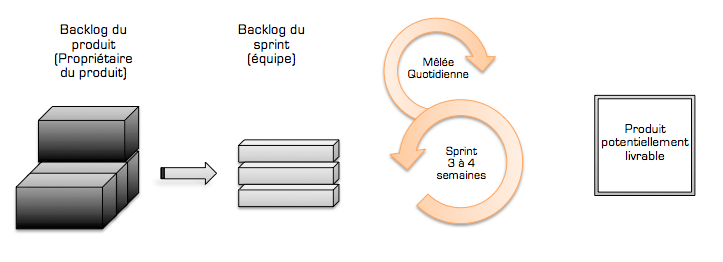
Today, Scrum is the most popular Agile method. The word comes from rugby, where a scrum is a formation of players. Scrum is based on “sprints”, fairly short periods that can range from a few hours to a month. Typically, and preferably, a sprint lasts two weeks. At the end of each sprint, the team presents what it has added to the product. Scrum involves three roles:
- The Product Owner: communicates the main objectives of the clients and end users, coordinates the involvement of users and stakeholders, and works with other product owners to ensure consistency.
- The Scrum Master: a member of the team whose aim is to optimise the team’s capacity to deliver. To do so, the Scrum Master helps the team work autonomously while continuing to improve.
- The development team (ideally fewer than ten people): what sets a Scrum team apart is that it has no internal hierarchy. A Scrum team is self-organising.
A few other terms are worth knowing to understand Scrum:
- The product backlog: this document contains the initial requirements, drawn up and prioritised with the client at the start of the project. It then evolves throughout the project as the client’s needs change.
- The sprint backlog: at the start of each sprint, the team sets a goal. Then, during the sprint planning meeting, the development team chooses which backlog items to deliver. Together, these items make up the sprint backlog.
- User story: a feature as described by the client.
- The daily scrum: a progress meeting held every day during the sprint.
Extreme Programming (XP)
This highly responsive method, designed for small and medium-sized projects, reduces the cost of change. The client steers the project through iterative cycles of one to two weeks and chooses which features to implement. The client gives the team their requirements as scenarios that can each be implemented within one iteration.
In XP, the team works in pairs who regularly review the code. This is known as collective code ownership: the aim is for every developer to be able to work on any part of the software’s internal structure. On top of this, automated tests check each feature requested by the client and ensure the product is of good quality.
Rapid Application Development (RAD)
This is the oldest of the Agile methods. It is based on a development cycle of 90 to 120 days, with five phases:
- initiation (preparing the organisation and the communication plan)
- scoping (analysing and expressing the requirements)
- design (design and modelling)
- construction (development and prototyping, which account for about 50% of the project)
- final quality control on a pilot site
| Method | How it works | Cycle length | Distinctive feature |
|---|---|---|---|
| Scrum | Sprints, at the end of which the team presents what it has added to the product | From a few hours to a month, ideally two weeks | Three roles: Product Owner, Scrum Master, self-organising team |
| Extreme Programming (XP) | The client chooses the features and steers the project through iterative cycles | One to two weeks | Pair programming, collective code ownership, automated tests |
| Rapid Application Development (RAD) | Five phases: initiation, scoping, design, construction, final check | 90 to 120 days | The oldest of the Agile methods |
Other Agile methods include the Rational Unified Process (RUP), Feature Driven Development (FDD) and the Dynamic Systems Development Method (DSDM).
The strengths of the Agile method
- The team rarely goes off track, because the method ensures good, constant communication between the client and the provider
- There is less documentation, so productivity increases
- Collaboration with the client happens daily
- A working version of the software is delivered frequently
- Technical excellence is a constant goal: testing is continuous
- Results become visible step by step, which avoids unpleasant surprises
In short, Agile is a modern methodology that brings significant productivity gains and lower production costs.
Frequently asked questions
What is the Agile method, in one sentence?
An iterative, collaborative approach that takes into account both the client’s initial needs and those that emerge during the project. The client is involved from start to finish and regularly receives a working version of the software.
Why is it called an “Agile” method?
The term refers to the ability to adapt to change: the client’s requests shape the project as it goes, instead of following a rigid plan.
What are the four principles of the Agile Manifesto?
Communication and team cohesion over tools and processes, the relationship between the team and the client over contract negotiation, well-built software over detailed documentation, and accepting change over a rigid plan.
What are the main Agile methods?
Scrum, the most popular, Extreme Programming (XP) and Rapid Application Development (RAD), the oldest. Others include RUP, FDD and DSDM.
What is a sprint in Scrum?
A short period, from a few hours to a month and ideally two weeks, at the end of which the team presents what it has added to the product. The items to deliver during the sprint make up the sprint backlog.
What are the benefits of the Agile method?
Constant communication with the client, less documentation, working versions delivered often, continuous testing and results that become visible step by step, which avoids unpleasant surprises.